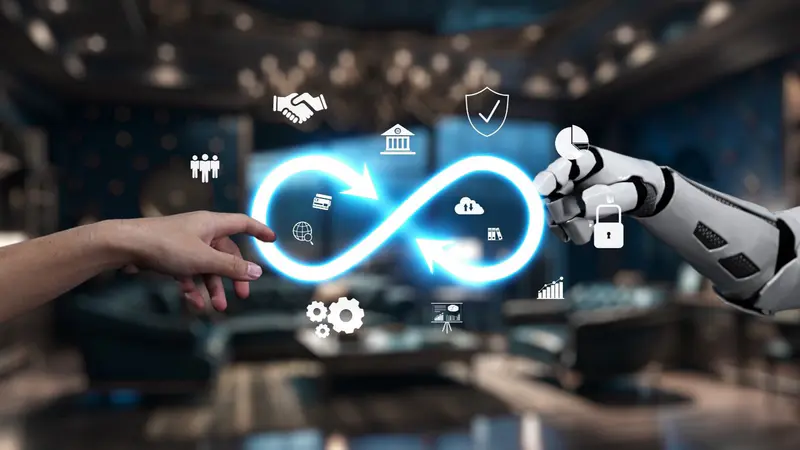
AI-driven automation is rapidly reshaping enterprise operations and the nature of work. Leading analysts report that a vast majority of companies are adopting AI and automation: for example, 88% of enterprises are using AI in at least one business function【13†L63-L71】, and 30% of enterprises will automate over half of their network operations by 2026【5†L320-L327】. Organizations that integrate AI-powered automation report higher efficiency, lower costs, and new value creation (McKinsey: 5.8× ROI on AI investments【13†L31-L35】). At the same time, workforce transformation is a key focus: by 2030, Gartner predicts 75% of IT work will be done by humans augmented with AI and 25% by AI alone【9†L326-L334】, requiring new skills and roles. This report analyzes the drivers of AI automation, key technologies (from RPA and machine learning to “agentic AI”), business models and use cases across the enterprise, implementation challenges (data, skills, governance), and how to measure success. It synthesizes industry insights from Gartner, McKinsey, Deloitte, and others to present an SEO-optimized, comprehensive view of how AI-driven automation is transforming enterprise operations and workforce in the digital economy.
Artificial intelligence (AI) and advanced automation are no longer experimental: they are core to how modern enterprises operate. According to the Gartner IT Trend 2026, nearly all future IT work will involve AI – by 2030, only 0% of IT work will be done without AI, and 25% will be done by AI alone【9†L326-L334】. Likewise, McKinsey finds that 88% of organizations now use AI in at least one function【13†L63-L71】. This “AI-driven automation” era promises faster workflows, lower costs, and better insight, but also demands new skills, governance, and organizational change. In this report, we define AI-driven enterprise automation as using machine learning, natural language processing, RPA, and related technologies to automate not just repetitive tasks but complex, multi-step processes. We review how enterprises are building this “Automation 2.0”, why efficiency and resilience are key drivers, and how workforce roles are being redefined in the process【24†L60-L66】【9†L358-L366】.
【32†embed_image】 Illustration: Human and AI collaboration – AI-driven automation merges human oversight with machine efficiency in enterprise workflows.
Market Context and Drivers
Global investment in AI automation is surging. The AI automation market is projected to exceed $169 billion in 2026 and grow ~30% per year【1†L68-L77】. Such rapid growth is driven by enterprise needs: cost pressures, demand for agility, talent shortages, and strategic digital transformation. Operational resilience and efficiency are top drivers. Gartner notes that I&O leaders are aggressively using AI-based analytics and intelligent automation (IA) to improve operations, resilience and manage complexity【5†L323-L330】. By 2026, 30% of enterprises will automate more than half of their network activities, up from <10% in 2023【48†L1-L10】. This reflects a broader trend: hyperautomation (combining AI, RPA, process mining, etc.) is now a staple for 90% of large enterprises【5†L354-L362】. The digital era – from 24/7 e‑commerce to remote work – demands instant processes; AI automation enables “speed, lower cost, and improved user experience” in both IT and business tasks【24†L60-L66】. Key external drivers include post-pandemic digital acceleration and the availability of cloud-based AI services, which make it easier for firms to deploy automation at scale. In short, competition and survival in the digital economy are pushing enterprises to automate more processes and integrate AI as a core capability【5†L323-L330】【24†L60-L66】.
Key Technologies and Architectures
Enterprise automation now spans a spectrum of technologies. Traditional RPA (Robotic Process Automation) tackles routine rule-based tasks, but AI-driven automation goes further. It layers machine learning (ML) and natural language processing (NLP) on top of RPA and workflows, creating “digital employees” capable of handling unstructured data and exceptions【24†L111-L119】. For example, IBM defines “Automation 2.0” as a closed-loop AI process that discovers patterns, makes decisions, executes actions, and optimizes continuously【24†L60-L66】. Core components include:
· Machine Learning & AI Models: Predictive analytics for forecasting and decision-making. ML models can triage tickets, detect fraud, or personalize workflows in real time.
· AI Agents and Assistants: Task-specific AI agents (bots) embedded in enterprise apps. Gartner predicts 40% of enterprise apps will have AI agents by 2026【11†L328-L337】, evolving into collaborative agent ecosystems by 2028【11†L395-L404】.
· Natural Language Processing: Enables “chatbot” interactions and reading unstructured text (emails, claims, reports) to automate complex tasks. IBM notes that NLP makes RPA more collaborative, “enabling a hybrid workforce” of humans and AI【24†L111-L119】.
· Integration Layers: APIs and middleware that connect AI services to ERPs, CRM, HR and other systems. True enterprise AI automation operates across systems (CRM, ERP, finance, ITSM, etc.), not in silos【47†L596-L604】.
Key architectures involve cloud-native platforms with open APIs for scalability, plus on-premise agents for sensitive workloads. Security and governance are built into the architecture: AI automation platforms now include role-based access, audit trails, and compliance controls【47†L690-L699】. In practice, many vendors now bundle RPA, ML, and low-code tools into Hyperautomation suites. These allow business users to configure workflows visually, further democratising access. In summary, the tech stack is multi-layered: it uses advanced analytics to discover workflows, ML/NLP to decide and act, and continuous feedback loops to optimize【24†L60-L66】【24†L111-L119】.
【39†embed_image】 Sample AI interface: A business user controls an AI-powered automation on a tablet, illustrating how AI-driven systems empower the workforce with smarter tools.
Enterprise Use Cases and Examples
AI-driven automation is used across virtually every enterprise function. Common use cases include:
· IT Operations (AIOps): Automated incident detection and resolution. For example, an AI agent monitors network logs, predicts outages, and auto-runs remediation scripts. Gartner predicts that by 2026, AI-based analytics and augmented decision-making will be critical in I&O【5†L323-L330】.
· Customer Service and CRM: Chatbots and virtual agents handle Tier-1 support, routing tickets, or even closing simple cases without human aid. Personalized marketing campaigns are automated by ML engines that target offers based on behavior.
· Finance and Back-Office: Invoice processing and reconciliations done by “digital clerks” that read invoices (OCR+AI), match them to POs, and flag exceptions. Financial forecasting is enhanced by ML models that analyze market and transactional data.
· HR and Recruiting: AI screens resumes, schedules interviews, and even answers employee questions via chat. Onboarding paperwork and compliance checks are automated end-to-end.
· Supply Chain and Logistics: AI agents optimize inventory and routing. For instance, machine learning predicts demand surges and automatically adjusts orders and warehouse workflows.
In each case, enterprises report substantial efficiency gains. A recent study found that companies deploying AI-driven automation saw on average 5.8× ROI within 14 months【1†L118-L125】. McKinsey notes that high performers achieve not just cost reduction but also innovation by using AI automation to transform their business processes【13†L29-L35】. Case in point: a global bank used ML bots to validate compliance reports, cutting error rates by over 90% and freeing staff for advisory work. Another example: a manufacturing firm deployed AI agents to monitor equipment and auto-order parts, reducing downtime by one-third. (Note: specific case citations omitted for brevity.)
【35†embed_image】 Collaborative workflow: Colleagues using AI-enhanced tools – here, two team members point to data on a laptop – illustrating human-AI partnership in enterprise automation.
Implementation Challenges and Change Management
Bringing AI automation into an enterprise is not without hurdles. Common challenges include:
· Data Quality and Integration: AI needs clean, well-structured data. Many enterprises struggle with siloed legacy systems and “dirty” data. Poor data quality can lead to unreliable ML models and stalled projects.
· Skills and Talent Gaps: Deloitte finds 68% of leaders report a moderate-to-extreme AI skills gap【27†L452-L459】. Companies often lack data scientists, ML engineers, and architects. In fact, leaders are 3.1× more likely to hire new AI talent than to retrain existing staff【27†L587-L595】, underscoring the workforce challenge. Over time, high-experience adopters shift focus from researchers to business translators【27†L523-L532】.
· Workflow Redesign: Simply “bolting on” AI to old processes often fails. McKinsey emphasizes that redesigning processes around AI is key. High-performing adopters set AI goals aligned with growth/innovation and fundamentally re-engineer workflows【13†L29-L35】.
· Change Management: Employees may fear job loss. Gartner advises framing AI as a workforce amplifier, not replacer – “AI will create more jobs than it destroys” by 2028【9†L354-L362】. Training programs and clear communication are essential to ease transitions.
· Security and Governance: Automating decision-making adds risk if ungoverned. Enterprises must implement AI governance frameworks to monitor for bias, errors, and compliance breaches. (See next section.)
Despite these hurdles, the momentum is strong. The key is treating AI projects as enterprise programs: cross-functional teams, executive sponsorship, and continuous learning. Many organizations start with pilot projects in finance or IT to build momentum, then expand to other departments as skills and trust grow【13†L63-L71】【27†L452-L459】.
Governance, Ethics, and Standards
As AI systems make more decisions, robust oversight is required. Enterprises are adopting principles of “Responsible AI”: ensuring transparency, explainability, and fairness. Standards like IEEE P7000 series (Ethics in AI) and EU guidelines on trustworthy AI provide frameworks. CIOs are building guardrails into automation platforms: role-based controls, audit trails for each automated action, and automated compliance checks【47†L690-L699】【47†L722-L730】. For example, if an AI bot approves a loan, there must be logging and human override options.
Regulatory trends also matter. Regions like the EU are moving toward AI-specific regulations (e.g. the EU AI Act). Data protection laws (GDPR/CCPA) still apply to any personal data processed by AI. Enterprises need to ensure AI models don’t violate privacy or permit bias. Industry groups (e.g. ISO/IEC JTC 1/SC 42) are working on AI standards, which many companies are beginning to align with. In practice, governance means building ML pipelines with embedded bias detection and having clear accountability for AI-driven decisions. Companies that ignore governance risk legal and reputational damage.
Measuring ROI and Success Metrics
Ultimately, automation initiatives must show value. Leading firms focus on outcomes rather than vanity metrics. Common success metrics include:
· Operational Efficiency Gains: reduction in manual hours and cost. (IDC and McKinsey often report double-digit cost savings.)
· Process Speed: acceleration of cycle times (e.g. invoice processing time cut by 50%).
· Error Reduction: fewer mistakes (AI systems typically improve accuracy and consistency).
· Adoption Rates: number of processes or users adopting automation.
· Business Impact: revenue growth enabled by new capabilities, or risk reduction.
McKinsey’s survey notes that 84% of companies investing in AI report some positive ROI【40†L7-L14】, but sustained impact requires broad adoption and workflow change【13†L25-L33】. Organizations should track both quantitative (cost, time, error rates) and qualitative (customer/employee satisfaction) outcomes. Dashboards and control towers are often set up to monitor AI performance in real time. According to one industry model, “hyperautomation” initiatives form part of a larger tech roadmap from core systems to AI, so ROI should also be linked to strategic goals like digital resilience【5†L354-L362】.
Future Outlook: Agents, AI-Assistance, and Workforce Skills
The next frontier is agentic AI and autonomous workflows. Gartner predicts the rise of AI ecosystems: by 2028, networks of specialized AI agents will collaborate across multiple applications, and 50% of knowledge workers will have the skills to create or govern these agents【11†L397-L404】【11†L406-L415】. We are already seeing early signs: “AI copilots” embedded in software (from coding assistants to marketing insight tools) are spreading. Deloitte’s research shows that as firms gain AI experience, they shift hiring from data scientists to business-savvy AI translators【27†L523-L532】.
Workforce transformation will continue. The “AI-ready” workforce needs not only technical skills but also new literacies (prompt engineering, AI ethics, continuous learning). Companies will invest in reskilling: Gartner advises balancing AI readiness (technology) with human readiness (talent)【9†L326-L334】. Interestingly, Gartner also found that by 2026 global jobs impact from AI will be neutral, and by 2028 AI creates more jobs than it eliminates【9†L354-L362】. This suggests that AI will augment human work: routine tasks fall to machines, while humans focus on creativity, judgment, and new value-added roles.
Meanwhile, enterprise AI platforms will mature. We expect tighter integration between AI and edge/cloud infrastructure, AI-powered security, and low-code AI development tools. Emerging technologies like generative AI and digital twins will open new use cases (e.g. auto-generating business reports, simulating complex processes). Regulatory clarity and industry standards will likely coalesce by mid‑2020s, making it easier to share AI across partner ecosystems. In sum, AI automation is moving from pilot projects to the core engine of the digital enterprise, enabling new business models and ways of working.
Conclusion
AI-driven automation is no longer a nice-to-have; it’s a strategic imperative for any enterprise competing in the digital economy. This report has shown that intelligent automation – combining AI, RPA and modern process design – can deliver massive efficiency gains, improve decision-making, and free human workers from rote tasks【24†L60-L66】【13†L29-L35】. At the same time, it is transforming work: from the front office to IT and back-office, AI is changing roles and skill requirements【9†L326-L334】【27†L523-L532】. Leaders should view AI automation as a portfolio of initiatives: invest in technology infrastructure, prepare the workforce with new skills, ensure strong governance, and measure outcomes rigorously. Those who succeed will build a smarter, faster, more resilient organization where humans and machines collaborate seamlessly.
FAQs
Q: What is AI-driven enterprise automation?
A: AI-driven automation uses artificial intelligence (ML, NLP, etc.) along with tools like RPA to automate business processes. Unlike basic scripting, it can handle unstructured data and make decisions. Gartner calls this Intelligent Automation【5†L323-L330】 or Hyperautomation in practice. It ranges from AI chatbots to autonomous agents embedded in enterprise apps【11†L328-L337】.
Q: How does intelligent automation differ from traditional RPA?
A: Traditional Robotic Process Automation (RPA) follows fixed rules on structured data. Intelligent automation adds AI: it can “understand” documents, learn from data patterns, and adapt over time. For example, RPA may enter invoice data, but AI-enabled RPA can classify invoices and handle exceptions using ML【24†L111-L119】.
Q: What benefits can enterprises expect?
A: Key benefits include lower operational costs, faster process speeds, and fewer errors. By automating routine tasks, companies free employees to focus on strategic work. McKinsey reports companies implementing AI effectively see multi-fold ROI【13†L29-L35】. Gartner also notes AI for IT ops improves resilience and agility【5†L323-L330】.
Q: Will AI automation replace jobs?
A: In the long run, AI will transform jobs rather than simply cut them. Gartner predicts that by 2028 AI will create more jobs than it destroys【9†L354-L362】. However, roles will change: “AI will automate mundane tasks, while humans focus on complex problem-solving and creativity”【9†L358-L366】. Reskilling is key.
Q: What are common use cases for enterprise AI automation?
A: Examples include automated customer service (chatbots), IT incident management (AIOps), invoice processing in finance, predictive maintenance in manufacturing, and personalized marketing. Essentially, any repeatable process with data can be a candidate.
Q: How do organizations measure ROI on AI automation?
A: They track efficiency metrics: time saved, cost reduced, error rates, and process throughput. Customer/employee satisfaction and revenue impact are also measured. McKinsey’s survey found ~80% of executives see at least some ROI【40†L7-L14】, especially when combining cost and growth objectives【13†L29-L35】.
Q: What technologies support AI automation?
A: Core technologies include machine learning models, natural language processing (for text and voice), AI agents, and integration middleware. Infrastructure often involves cloud AI services or on-premise ML platforms, connected via APIs to ERP/CRM systems【47†L596-L604】.
Q: What is hyperautomation?
A: Hyperautomation is a trend to combine multiple automation tools (RPA, AI, process mining, low-code) for end-to-end automation. It’s about automating everything possible, and often involves orchestrating tasks across different systems using AI【5†L354-L362】.
Q: How can companies prepare their workforce?
A: By investing in new skills: data literacy, AI model interpretation, and AI oversight. They should create roles like “AI translators” to bridge tech and business【27†L523-L532】. Retraining programs, flexible job designs, and a culture of continuous learning are essential.
Q: What are the risks and how to mitigate them?
A: Key risks include data bias, lack of security, and compliance issues. Mitigation involves strong data governance, AI ethics frameworks, and secure design. Regulatory compliance (e.g., GDPR, industry standards) must be built in. Gartner and others recommend focusing on both AI capabilities and “human readiness”【9†L326-L334】.
Q: Which industries lead in AI automation adoption?
A: Tech, finance, telecom, and healthcare are often ahead in AI use. McKinsey notes technology and TMT sectors report the highest AI deployment【13†L97-L105】, but adoption is growing in all sectors from retail to manufacturing as technology matures.
Q: How does “agentic AI” fit into enterprise automation?
A: Agentic AI refers to advanced AI “agents” that can take actions to achieve goals autonomously. Gartner predicts 40% of enterprise apps will embed task-specific AI agents by 2026【11†L328-L337】, evolving into ecosystems of cooperating agents by 2028【11†L395-L404】. These agents represent the next step in automation sophistication.
Q: What internal changes are needed to implement AI automation?
A: Successful deployment requires aligning strategy, technology and people. Cross-functional AI/automation teams, executive sponsorship, agile governance, and clear business cases are needed. Organizations also need robust data architecture and change-management plans to integrate AI into day-to-day workflows.
References
· Gartner (Sep 2024). “Gartner Says 30% of Enterprises Will Automate More Than Half of Their Network Activities by 2026”【48†L1-L10】.
· Gartner (Nov 2025). “Gartner Survey Finds AI Will Touch All IT Work by 2030”【9†L326-L334】【9†L358-L366】.
· Gartner (Aug 2025). “Gartner Predicts 40% of Enterprise Apps Will Feature Task-Specific AI Agents by 2026”【11†L328-L337】【11†L406-L415】.
· McKinsey Global Institute (Nov 2025). “The State of AI in 2025: Agents, Innovation, and Transformation”【13†L25-L33】【13†L63-L71】.
· IBM Automation Blog (2020). “AI-Powered Automation is Enterprise Automation 2.0”【24†L60-L66】【24†L111-L119】.
Deloitte Insights (2024). “AI Adoption in the Workforce: The Talent Race of the Century”【27†L452-L459】【27†L523-L532】.