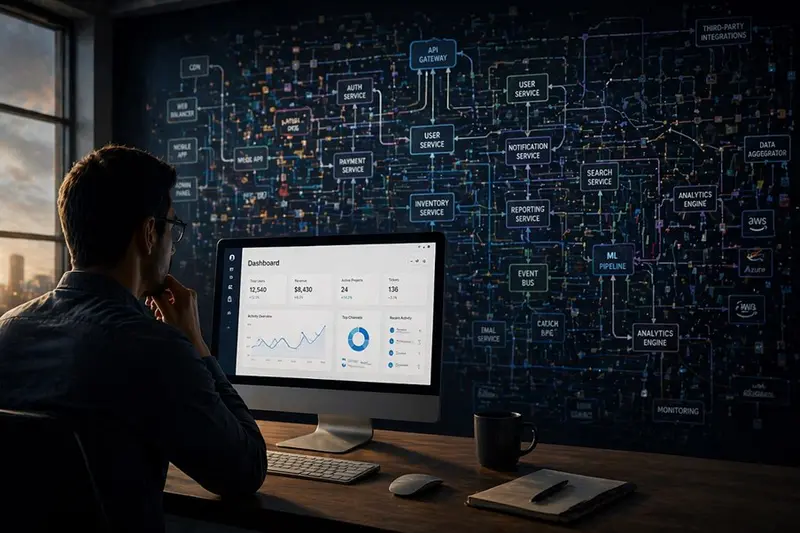
Modern technology has never felt easier to use.
Interfaces are cleaner. Apps are intuitive. Processes that once required training now take seconds to understand. From cloud platforms to AI-powered tools, everything appears designed for simplicity.
But beneath this surface, something very different is happening.
Technology is not becoming simpler.
It is becoming increasingly complex—just not in ways users can see.
This growing gap between perceived simplicity and underlying complexity is what can be called the interface illusion. It is one of the most defining—and least discussed—shifts in modern technology.
When Simplicity Is Engineered, Not Real
The simplicity we experience today is not a natural outcome of technological progress.
It is engineered.
Behind every intuitive interface lies:
- Multiple layers of infrastructure
- Interconnected systems
- Automated decision processes
- Continuous data flows
What appears as a single action on a screen often triggers dozens of processes behind the scenes.
This reflects a broader shift in enterprise technology, where systems are becoming more integrated and interconnected, even as user-facing experiences are simplified (Forbes).
The result is a paradox:
The easier technology feels, the more complex it often is underneath.
The Shift From Tools to Systems
Historically, technology functioned as a set of tools.
Each system operated independently. Users understood how it worked because the scope was limited.
Today, technology operates as an ecosystem.
Applications are no longer standalone. They are connected through:
- APIs
- Cloud platforms
- Data pipelines
- AI models
This interconnected structure means that a single action—such as updating a record or running a report—can involve multiple systems working simultaneously.
According to Deloitte, modern enterprise technology is moving toward fully integrated, AI-driven operations where automation and interconnected systems are becoming the standard rather than the exception (Deloitte).
This transformation increases capability—but also complexity.
Why Complexity Is Being Hidden
If technology is becoming more complex, why does it feel simpler?
Because complexity is being deliberately abstracted.
Design now prioritizes:
- Ease of use
- Speed of interaction
- Minimal friction
Users are not expected to understand the system—they are expected to experience it.
This is similar to how electricity works in everyday life.
People don’t need to understand how power grids function to use them.
Technology is moving in the same direction.
As one industry perspective notes, AI will eventually become so embedded that users won’t actively interact with it—they will simply experience its outcomes (Deloitte).
The Trade-Off: Simplicity vs. Transparency
This abstraction comes with a trade-off.
As systems become easier to use, they become harder to understand.
Users gain convenience—but lose visibility.
This creates challenges:
- It becomes harder to trace how decisions are made
- It becomes difficult to diagnose problems
- It reduces awareness of underlying risks
In highly automated environments, decisions may be influenced by systems that users do not fully understand.
This is particularly relevant as AI systems evolve from providing insights to making autonomous decisions in real time (Forbes).
The Rise of Invisible Decision-Making
One of the most significant consequences of the interface illusion is the shift toward invisible decision-making.
Technology increasingly:
- Recommends actions
- Automates workflows
- Adjusts outcomes dynamically
In many cases, these decisions happen without direct human input.
This is especially evident in the rise of autonomous and agent-based AI systems, which are designed to operate independently across complex workflows (Analytics Insight).
While this increases efficiency, it also changes the nature of control.
Decisions are no longer always made by users—they are made for them.
Why This Feels Effortless—But Isn’t
From the user’s perspective, everything feels smoother.
Processes are faster. Interfaces are cleaner. Results are immediate.
But this effortlessness is the result of increasing system sophistication.
Behind the scenes:
- Data is being processed continuously
- Algorithms are evaluating scenarios
- Systems are coordinating across environments
The complexity has not disappeared.
It has been relocated.
The Business Impact of Hidden Complexity
For organizations, the interface illusion has significant implications.
On one hand, it enables:
- Faster adoption of technology
- Improved user experience
- Greater operational efficiency
On the other hand, it introduces new risks:
- Overreliance on systems that are not fully understood
- Difficulty managing interconnected dependencies
- Increased vulnerability to system-level failures
As businesses scale their use of technology, they are not just adopting tools—they are managing ecosystems.
And ecosystems are inherently more complex.
Why Technology Feels “Done” When It Isn’t
Another effect of the interface illusion is the perception that technology is complete.
When systems feel seamless, it creates the impression that:
- Processes are fully optimized
- Problems are solved
- Systems are stable
But in reality, modern technology is in a constant state of evolution.
Systems are:
- Continuously updated
- Constantly optimized
- Regularly reconfigured
This ongoing change adds another layer of complexity—one that is largely invisible to users.
The Growing Gap Between Users and Systems
As complexity increases and visibility decreases, a gap emerges.
Users interact with simple interfaces.
But the systems behind those interfaces become:
- More advanced
- More opaque
- More autonomous
This creates a situation where:
The people using technology understand it less than ever before—while relying on it more than ever.
This gap is not necessarily a problem—but it requires new ways of thinking.
Rethinking Control in a Simplified World
In traditional systems, control came from understanding.
Users knew how processes worked and could intervene when needed.
In modern systems, control is shifting.
It is no longer about understanding every component.
It is about:
- Trusting systems
- Setting boundaries
- Monitoring outcomes
This requires a different mindset.
Not less control—but a different kind of control.
Why This Matters for the Future of Technology
The interface illusion is not a temporary trend.
It is the direction technology is moving toward.
As systems become more advanced, they will:
- Become less visible
- Require less direct interaction
- Operate more autonomously
This will further increase the gap between:
- What users experience
- What systems actually do
And managing that gap will become a central challenge for businesses.
A New Kind of Technological Literacy
In this environment, technological literacy will need to evolve.
It will no longer be enough to know how to use tools.
Organizations will need to understand:
- How systems interact
- Where complexity exists
- How decisions are being made
Not at a technical level—but at a conceptual one.
Because even if complexity is hidden, its impact is not.
Final Thought: The Simplicity You See
Technology today feels simple.
That is by design.
But simplicity at the surface does not mean simplicity underneath.
In fact, the opposite is often true.
The more seamless technology becomes, the more sophisticated the systems behind it.
And the real challenge for businesses is not learning how to use these systems.
It is understanding what lies beneath them.
Because in a world where everything feels effortless, the greatest risks—and the greatest opportunities—are often the ones you don’t see.