Technology history is often told through visible breakthroughs.
The personal computer transformed offices. The internet connected the world. Smartphones placed unprecedented computing power into our hands. More recently, artificial intelligence has emerged as the defining technological conversation of this decade.
These innovations dominate headlines because they are easy to identify. They are tangible, consumer-facing, and often disruptive in ways that immediately capture public attention.
Yet history suggests that some of the most significant technological revolutions are not always the most visible.
Electricity fundamentally reshaped economies without becoming a daily topic of conversation. The shipping container transformed global trade while remaining virtually unnoticed by consumers. The same phenomenon is unfolding today across the digital economy.
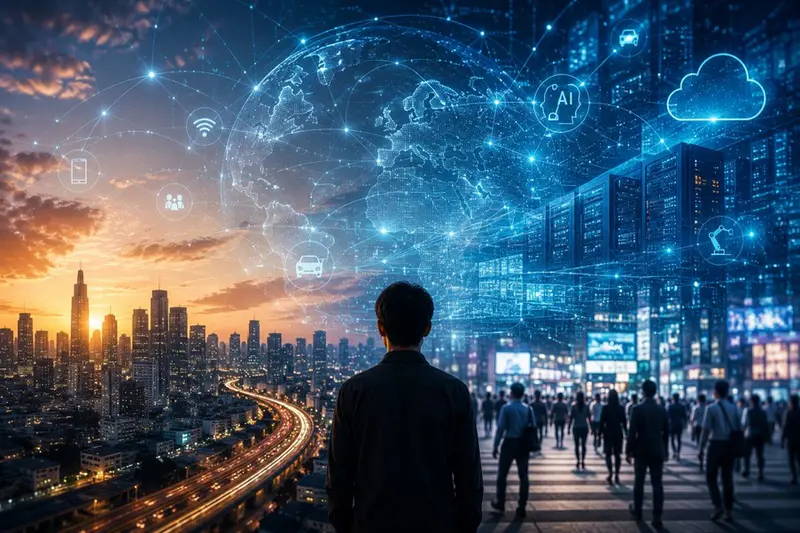
A profound technological transformation is taking place beneath the surface of modern life. It is not driven by a single device, application, or platform. Instead, it is being built through interconnected layers of cloud infrastructure, artificial intelligence, cybersecurity systems, intelligent automation, and advanced digital networks.
Most people rarely see these technologies directly. Yet they increasingly determine how businesses operate, how industries compete, and how economies grow.
Organizations worldwide are significantly increasing spending on artificial intelligence and cybersecurity as digital infrastructure becomes central to long-term business strategy (Source: https://www.techradar.com/pro/uk-businesses-are-spending-heavily-on-ai-and-cybersecurity-despite-fear-that-new-tech-could-expose-new-cyber-risks).
The irony is striking. The technologies attracting the greatest corporate investment today are often the ones consumers notice the least.
That raises an important question: could the most powerful technology revolution be the one happening largely out of sight?
From Products to Platforms
For much of the digital age, innovation was measured through products.
Consumers purchased faster computers, more advanced mobile devices, and increasingly sophisticated software. Businesses upgraded hardware and invested in new systems. Technological progress was visible and easy to quantify.
Today, however, value creation is shifting away from products and toward platforms.
Consider a seemingly simple online purchase. What appears to be a straightforward transaction is actually supported by a vast ecosystem of technologies operating simultaneously behind the scenes. Cloud servers process requests, cybersecurity systems verify identities, artificial intelligence analyzes behavior, logistics algorithms coordinate deliveries, and payment platforms facilitate transactions.
The customer experiences convenience.
The technology remains invisible.
This shift mirrors earlier infrastructure revolutions. Few people think about the electricity grid when turning on a light switch. Likewise, modern consumers rarely consider the digital infrastructure supporting the services they use every day.
Technology is increasingly becoming a utility—essential, pervasive, and largely unnoticed.
Why Cloud Computing Has Become the Foundation of Modern Business
Among the technologies driving this transformation, cloud computing stands out as one of the most important.
Despite its widespread adoption, many people still associate the cloud primarily with online storage. In reality, cloud infrastructure has evolved into a foundational component of modern business operations.
Organizations rely on cloud platforms to host applications, store data, support collaboration, scale operations, and accelerate innovation. Cloud adoption continues to accelerate as enterprises seek greater flexibility, resilience, and operational efficiency in a rapidly changing business environment (Source: https://www.deloitte.com/us/en/insights/industry/technology/technology-media-telecom-outlooks/technology-industry-outlook.html).
The strategic importance of cloud technology extends far beyond cost savings.
Startups can launch globally without investing heavily in physical infrastructure. Established corporations can modernize legacy systems while minimizing disruption. Businesses can respond to changing market conditions with a level of agility that was difficult to achieve only a decade ago.
In many respects, cloud infrastructure has become the digital equivalent of highways, ports, and power grids.
It enables economic activity without drawing attention to itself.
The smoother it works, the less visible it becomes.
Artificial Intelligence's Real Impact Is Happening Quietly
Few technologies have generated as much excitement as artificial intelligence.
Public discussions often focus on chatbots, content generators, and futuristic predictions about automation. While these developments are noteworthy, they represent only a small portion of AI's broader impact.
The more significant transformation is occurring within business operations.
Organizations across industries are embedding artificial intelligence into decision-making processes, customer experiences, supply chain management, risk assessment, and operational planning. AI is helping businesses forecast demand, identify inefficiencies, improve productivity, and uncover insights hidden within vast datasets.
Artificial intelligence is increasingly recognized as a key driver of productivity growth and economic development across multiple sectors worldwide (Source: https://www.worldbank.org/en/publication/dptr2025-ai-foundations).
Interestingly, customers often remain unaware of AI's involvement.
A bank detects fraud more effectively.
A retailer improves product recommendations.
A logistics provider reduces delivery times.
A healthcare institution streamlines administrative processes.
In each case, artificial intelligence operates behind the scenes, improving outcomes without becoming the center of attention.
Its greatest success may ultimately be its ability to disappear into the background while delivering measurable value.
Trust Is Becoming the New Competitive Advantage
As digital technologies become increasingly integrated into business operations, trust is emerging as one of the most valuable assets an organization can possess.
Every online interaction relies on confidence.
Customers trust businesses to protect sensitive information. Organizations trust technology providers to secure critical infrastructure. Governments trust digital systems to support essential services.
Without trust, digital transformation cannot succeed.
This reality has elevated cybersecurity from a technical consideration to a strategic business priority.
Organizations continue increasing cybersecurity investments as digital systems become more interconnected and sophisticated. At the same time, the rapid adoption of AI and cloud technologies is introducing new security challenges that require constant vigilance (Source: https://www.techradar.com/pro/security/new-research-reveals-ai-is-fueling-an-unprecedented-surge-in-cloud-security-risks).
The relationship between innovation and security is becoming inseparable.
Businesses can no longer treat cybersecurity as an afterthought. Instead, resilience must be embedded into systems from the outset.
The companies that successfully balance innovation with security are likely to earn greater trust from customers, investors, and stakeholders.
In the digital economy, trust may prove to be the most valuable currency of all.
The Emergence of Intelligent Infrastructure
Traditional infrastructure was designed to support activity.
Today's infrastructure is beginning to participate in it.
Modern networks can monitor performance in real time. Systems can identify anomalies before they become problems. Platforms can adapt automatically to changing demand conditions. Intelligent applications can optimize operations without requiring constant human intervention.
This evolution is giving rise to what many experts describe as intelligent infrastructure.
Unlike conventional systems that require extensive oversight, intelligent infrastructure is capable of learning, adapting, and continuously improving.
Advances in artificial intelligence, automation, cloud computing, and connectivity are increasingly converging to create adaptive systems capable of supporting more efficient and resilient operations (Source: https://www.mckinsey.com/~/media/mckinsey/business%20functions/mckinsey%20digital/our%20insights/the%20top%20trends%20in%20tech%202025/mckinsey-technology-trends-outlook-2025.pdf).
The implications extend well beyond technology departments.
Intelligent infrastructure influences customer service, operational efficiency, financial performance, and strategic decision-making.
Organizations that successfully harness these capabilities are positioning themselves to compete more effectively in increasingly dynamic markets.
Technology Remains a Human Story
Despite rapid advances in automation and machine intelligence, technology remains fundamentally about people.
Every technological breakthrough ultimately serves a human purpose.
Businesses invest in innovation to improve customer experiences. Governments pursue digital transformation to strengthen public services. Employees use advanced tools to increase productivity and focus on higher-value work.
Perhaps one of the most interesting aspects of today's technological landscape is how innovation is spreading beyond traditional technology teams.
Healthcare professionals are using advanced analytics to improve patient outcomes. Financial institutions are leveraging machine learning to enhance risk management. Manufacturers are deploying intelligent systems to optimize production and reduce waste.
Technology is becoming less specialized and more accessible.
As digital tools become easier to use, innovation is no longer confined to technical experts. It is becoming embedded throughout entire organizations.
This democratization of technology may prove to be one of the most significant developments of the coming decade.
Looking Beyond the Headlines
Every era produces technological trends that capture public imagination.
Some live up to expectations. Others fade into obscurity.
What makes the current moment unique is not the emergence of a single breakthrough but the simultaneous maturation of multiple foundational technologies.
Artificial intelligence is advancing rapidly.
Cloud infrastructure continues to expand.
Cybersecurity capabilities are becoming more sophisticated.
Automation is improving efficiency across industries.
Digital connectivity is enabling entirely new business models.
Together, these technologies are creating an ecosystem far more powerful than any individual innovation.
The most important changes may not come from the technologies making headlines today. Instead, they may emerge from the quiet accumulation of improvements occurring beneath the surface of everyday life.
Much like electricity transformed society without becoming the center of attention, tomorrow's most influential technologies may become so integrated into daily operations that people stop noticing them altogether.
And that may be the ultimate measure of technological success.
When innovation becomes invisible, it often means it has become indispensable.
The technology revolution shaping the future is not limited to the devices we carry or the applications we use. It is unfolding within the networks, platforms, algorithms, and infrastructures quietly powering modern life.
The organizations that recognize this shift early will not simply adapt to the future.
They will help build it.