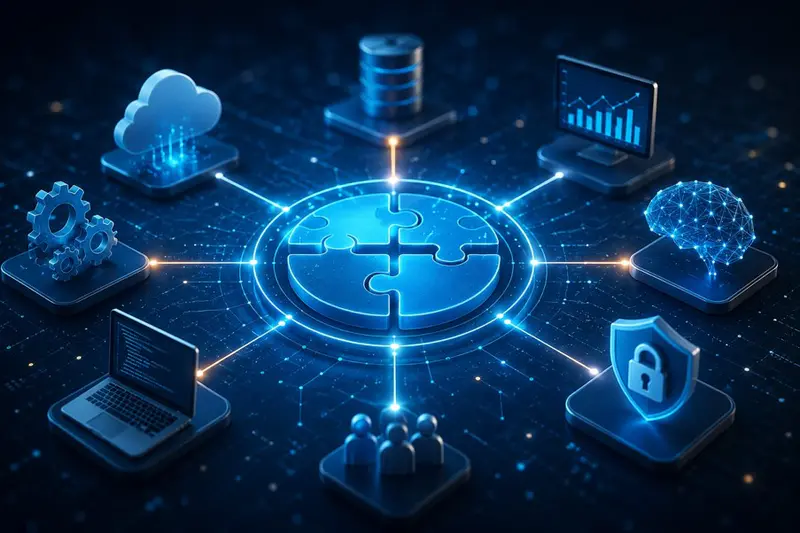
For much of the past decade, the technology conversation has revolved around breakthroughs.
Artificial intelligence became more capable. Cloud computing became more powerful. Automation expanded across industries. Connected devices multiplied. Every year seemed to introduce another innovation promising to reshape the way businesses operate.
Those breakthroughs have undoubtedly transformed the corporate world.
Yet an interesting shift is beginning to emerge.
Many organisations are discovering that their greatest competitive advantage no longer comes from acquiring another technology platform. Instead, it comes from making existing technologies work together more effectively.
In boardrooms, technology strategies are gradually moving away from chasing the newest innovation and toward solving a more practical challenge: integration.
Companies have accumulated cloud platforms, enterprise software, collaboration tools, artificial intelligence applications, cybersecurity solutions and data systems over many years. Individually, many perform exceptionally well. Together, they often operate in isolation.
Closing those gaps may become one of the most important business opportunities of the coming decade.
Technology Has Reached a New Stage of Maturity
Early digital transformation focused on adoption.
Businesses invested in cloud infrastructure.
They digitised paper-based processes.
They introduced collaboration platforms.
They automated repetitive workflows.
These investments created enormous value.
Today, many organisations have already completed much of that initial transformation.
The next challenge is different.
How can information move seamlessly between systems?
How can departments share insights more effectively?
How can technology simplify decision-making instead of creating additional complexity?
These questions reflect a broader evolution in corporate technology strategy.
Success increasingly depends less on the number of digital tools a company owns and more on how effectively those tools operate together.
According to the World Economic Forum, digital technologies are becoming increasingly interconnected, making integration, governance and responsible implementation central to long-term business competitiveness. https://www.weforum.org
Technology maturity is shifting attention from acquisition toward optimisation.
Data Loses Value When It Remains Isolated
Every business generates enormous volumes of information.
Sales teams collect customer insights.
Finance departments monitor performance.
Operations generate production data.
Human resources manage workforce information.
Marketing tracks customer engagement.
Individually, these datasets provide valuable perspectives.
Collectively, they can transform business decision-making.
The challenge is that many organisations continue storing information across disconnected systems.
When data remains fragmented, leaders often struggle to develop a complete understanding of business performance.
Integration addresses this challenge.
Modern technology platforms increasingly allow information to flow securely across departments, enabling faster reporting, better forecasting and more informed strategic decisions.
The Organisation for Economic Co-operation and Development has highlighted that data governance and digital integration play an increasingly important role in improving productivity, innovation and economic resilience. https://www.oecd.org
Data becomes most valuable when it connects people rather than systems alone.
Artificial Intelligence Depends on Connected Information
Artificial intelligence receives significant attention for its analytical capabilities.
Its effectiveness, however, depends heavily upon the quality of the information it receives.
Even the most advanced AI models cannot consistently produce valuable insights if underlying business information remains fragmented, inconsistent or outdated.
This explains why many organisations are investing in data integration before expanding artificial intelligence initiatives.
Clean, well-governed information improves forecasting.
Connected systems enhance automation.
Integrated workflows produce more reliable insights.
Artificial intelligence therefore becomes an outcome of strong digital foundations rather than a substitute for them.
Businesses increasingly recognise that successful AI strategies begin with successful information management.
Integration Improves Customer Experience
Technology integration influences customers more than many organisations realise.
Customers rarely see internal software platforms.
They simply experience the outcomes.
Orders are processed accurately.
Support teams respond quickly.
Information remains consistent across communication channels.
Digital services operate smoothly.
Achieving these outcomes depends upon systems sharing information efficiently.
When customer records, inventory, finance and service platforms communicate effectively, businesses respond more confidently and consistently.
The result is not simply operational efficiency.
It is a noticeably better customer experience.
Technology therefore becomes less visible while becoming more valuable.
Operational Simplicity Creates Competitive Advantage
Businesses often assume digital transformation inevitably increases complexity.
In reality, successful technology strategies frequently reduce it.
Integrated systems minimise duplicate data entry.
Automation removes repetitive administrative tasks.
Employees spend less time moving information between platforms.
Decision-makers receive more accurate reporting.
These improvements create operational simplicity.
Simplicity does not mean reducing technological sophistication.
It means allowing technology to handle complexity so people can focus on higher-value work.
Companies increasingly recognise that operational simplicity improves productivity, employee satisfaction and organisational agility simultaneously.
Human Collaboration Becomes More Effective
One overlooked benefit of integration is its impact on collaboration.
Disconnected systems frequently create organisational silos.
Departments work efficiently within their own technology environments while struggling to exchange information with colleagues elsewhere.
Integrated platforms encourage broader collaboration.
Finance gains greater visibility into operational performance.
Sales teams understand customer support history.
Leadership accesses consistent information across the organisation.
Employees spend less time reconciling conflicting reports and more time solving business challenges.
Technology therefore strengthens communication rather than replacing it.
The World Bank continues to emphasise that digital transformation contributes most effectively to economic development when technology improves productivity, expands access to information and strengthens institutional capability. https://www.worldbank.org
Connected organisations often become more collaborative organisations.
I'll continue the article seamlessly from Part 1.
Cybersecurity Begins with Connected Systems
As organisations become more digital, cybersecurity has become inseparable from technology strategy.
For many years, security was often viewed as a specialised technical function operating alongside the wider business. Today, it is increasingly embedded into every technology decision.
Integration plays an important role in this evolution.
When systems operate in isolation, security teams often struggle to maintain consistent visibility across the organisation. Information becomes fragmented, alerts remain disconnected and potential vulnerabilities become harder to identify.
Integrated platforms allow organisations to monitor activity more effectively, automate security processes and respond more quickly to emerging risks.
This does not eliminate cyber threats.
It strengthens an organisation's ability to manage them.
Modern cybersecurity therefore depends as much on visibility as it does on technology.
Digital Resilience Is Becoming a Business Priority
Business continuity once focused primarily on recovering from unexpected disruptions.
Today's organisations increasingly pursue resilience as an ongoing capability.
Technology infrastructure is designed to continue operating during periods of increased demand.
Cloud environments provide greater operational flexibility.
Automated monitoring identifies performance issues before they affect customers.
Integrated platforms improve recovery planning by reducing dependence on isolated systems.
These capabilities allow organisations to adapt more confidently to changing market conditions.
Resilience is no longer simply about responding effectively after disruption occurs.
It is about building systems capable of reducing disruption in the first place.
Companies that invest consistently in resilient technology infrastructure often improve operational confidence while strengthening long-term competitiveness.
Leadership Is Moving from Technology Ownership to Technology Strategy
Technology decisions were once concentrated largely within information technology departments.
That responsibility has broadened significantly.
Today, executive leadership teams increasingly discuss digital strategy alongside finance, operations, customer experience and long-term business planning.
This reflects an important change.
Technology is no longer viewed simply as operational infrastructure.
It has become a strategic business capability.
Leaders increasingly ask broader questions.
How can technology improve productivity?
How can data support better decisions?
How can digital platforms strengthen customer relationships?
How can artificial intelligence complement employee expertise?
These conversations extend well beyond software procurement.
They shape organisational direction.
Successful companies increasingly treat technology strategy as business strategy.
Sustainable Innovation Depends on Strong Foundations
Innovation often attracts attention through new products and emerging technologies.
Lasting innovation, however, usually depends upon disciplined execution.
Organisations that invest patiently in digital foundations frequently innovate more successfully than those constantly pursuing the newest technology trends.
Reliable infrastructure supports experimentation.
Well-governed information improves decision-making.
Integrated systems reduce operational friction.
Employees gain confidence to adopt new tools because existing platforms already function effectively.
Sustainable innovation therefore builds progressively.
Each improvement strengthens the next.
Companies that understand this relationship often achieve more consistent long-term results than organisations relying solely on rapid technological adoption.
The Future Will Reward Connected Organisations
Over the coming decade, businesses will continue adopting artificial intelligence, automation, cloud computing and advanced analytics.
These technologies will undoubtedly reshape industries.
The companies creating the greatest value, however, are unlikely to be those acquiring the largest number of digital tools.
They will be those integrating those technologies into coherent business ecosystems.
Customers will experience smoother digital interactions.
Employees will collaborate more effectively.
Leaders will make faster and better-informed decisions.
Operations will become increasingly efficient.
Technology will quietly become more invisible while delivering greater strategic value.
The International Data Corporation (IDC) notes that organisations with integrated digital ecosystems are better positioned to improve operational efficiency, strengthen customer engagement and accelerate long-term digital transformation. https://www.idc.com/
Integration is becoming one of the defining characteristics of digitally mature organisations.
Conclusion
Technology has entered a new phase.
For many years, competitive advantage came from adopting the latest innovations before competitors.
That race is evolving.
Today, lasting advantage increasingly comes from connecting technologies, people and information into systems that operate seamlessly together.
Artificial intelligence performs better when supported by integrated data.
Employees collaborate more effectively when information flows freely.
Customers enjoy better experiences when digital services operate consistently across every interaction.
Leaders make stronger decisions when organisations share a common understanding of performance.
None of these outcomes depends upon a single breakthrough technology.
They depend upon thoughtful integration.
As digital transformation continues, businesses will undoubtedly continue investing in artificial intelligence, automation and cloud computing.
Yet the companies that extract the greatest value from those investments are likely to be those that first build strong digital foundations.
The future of technology may therefore be defined less by individual innovations than by how intelligently those innovations work together.
In an increasingly connected business environment, integration is no longer simply an IT objective.
It is becoming one of the most important drivers of long-term competitive advantage.