For years, the technology industry has focused on one central idea: automation.
Businesses invested heavily in artificial intelligence, machine learning, cloud computing, robotics, and predictive systems designed to improve efficiency, reduce costs, and accelerate operations. Across industries, companies embraced digital transformation with extraordinary speed, convinced that the future belonged to organizations capable of automating as much work as possible.
And in many ways, they were right.
Artificial intelligence is already reshaping how companies operate. Algorithms can analyze enormous datasets in seconds, automate repetitive workflows, generate content, forecast customer behavior, optimize supply chains, and support real-time decision-making. Entire sectors are being transformed by technologies that only a few years ago felt experimental.
But beneath the excitement surrounding AI, another realization is quietly emerging — one that may ultimately define the next era of technological progress.
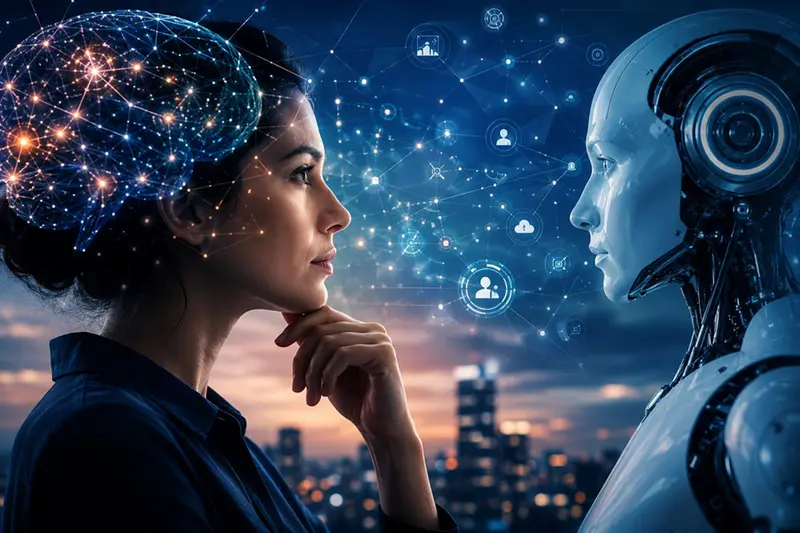
As machines become smarter, human intelligence is becoming more valuable, not less.
This is the paradox reshaping the future of technology.
The businesses most likely to lead the next decade may not simply be the companies with the most advanced AI systems. They may be the organizations that best understand how human judgment, creativity, emotional intelligence, and adaptability can work alongside technology rather than compete against it.
Because the future of technology may not belong to machines alone.
It may belong to the businesses that learn how humans and intelligent systems can amplify one another more effectively than anyone else.
The Age of Pure Automation Is Ending
The first major phase of digital transformation focused heavily on replacing manual work.
Automation promised speed, efficiency, and scalability. Businesses streamlined operations by digitizing processes, eliminating repetitive tasks, and reducing dependence on labor-intensive workflows.
For years, this strategy drove extraordinary gains in productivity.
But as AI becomes more advanced, companies are discovering the limits of automation-first thinking.
Technology excels at processing information, identifying patterns, and executing predictable tasks at remarkable speed. Yet modern business environments increasingly depend on capabilities machines still struggle to replicate effectively — contextual reasoning, emotional understanding, ethical judgment, creativity, and long-term strategic thinking.
This shift is becoming increasingly visible across industries.
Microsoft’s 2026 Work Trend Index found that while employees are rapidly adopting AI tools, many organizations still struggle to redesign work structures around meaningful human-AI collaboration. The report describes a growing “transformation paradox” in which businesses embrace AI technology faster than they adapt organizational systems to support it effectively. (TechRadar)
This distinction matters enormously.
The next stage of technological evolution is not simply about increasing automation.
It is about redesigning work itself.
Why Human Judgment Is Becoming a Competitive Advantage
One of the most surprising outcomes of the AI revolution is the rising importance of human judgment.
Algorithms can generate recommendations, analyze data, and automate workflows, but they still struggle with ambiguity, ethics, emotional nuance, and contextual interpretation. Modern business decisions increasingly involve exactly those kinds of challenges.
Executives must navigate geopolitical instability, cybersecurity threats, workforce transformation, customer trust, regulatory complexity, and rapidly changing consumer expectations — areas where purely data-driven systems remain limited.
As a result, businesses are quietly shifting their focus.
Organizations are investing more heavily in leadership development, communication skills, adaptability, and strategic reasoning precisely because these human capabilities become more valuable as automation expands.
IDC’s recent analysis of workplace transformation described modern organizations as entering an era of “human-AI teams,” where people who effectively collaborate with intelligent systems gain major advantages in creativity, productivity, and innovation. (IDC)
This marks a profound change in how businesses think about technology.
For decades, technology strategy focused primarily on efficiency.
Increasingly, however, future competitiveness may depend on how effectively organizations combine machine capability with human intelligence.
The Hidden Risk Businesses Are Beginning to Recognize
Despite widespread enthusiasm around AI adoption, some organizations are beginning to confront a less visible challenge: overdependence on automation.
As businesses automate more workflows, concerns are emerging about what happens when human expertise gradually erodes over time.
This issue is particularly important in industries where judgment, intuition, and contextual reasoning remain essential.
Researchers studying long-term AI integration have identified what some describe as “intuition rust” — the gradual weakening of human expertise when workers rely too heavily on automated systems for decision-making. In high-skill professions, excessive automation may eventually reduce critical thinking capabilities rather than strengthen them. (arXiv)
This concern extends beyond technical expertise.
If employees become dependent on AI-generated insights without maintaining independent judgment, businesses risk losing creativity, skepticism, and strategic insight — qualities that often drive innovation itself.
Technology can improve execution dramatically.
But businesses still need people capable of questioning assumptions, identifying hidden risks, and imagining possibilities beyond existing systems.
That is why many organizations are beginning to rethink the relationship between technology and human capability altogether.
The Future of Work Is Being Quietly Redefined
The integration of AI is not simply changing tools.
It is transforming the structure of work itself.
Traditional workplace models were built around repetitive tasks, standardized roles, and clearly defined operational systems. But intelligent technologies increasingly automate routine work, shifting human roles toward interpretation, oversight, creativity, and collaboration.
This transition is forcing organizations to redesign workflows, leadership structures, and talent strategies.
According to Gartner’s Future of Work Trends report, businesses entering 2026 face growing pressure to create operating models centered on adaptability, human-machine collaboration, and skills-based workforce development rather than traditional hierarchical structures. (Gartner)
This evolution changes what businesses value in employees.
Technical knowledge remains important, but future workforce demand increasingly centers on communication, problem-solving, emotional intelligence, creativity, and adaptability — skills machines cannot easily replicate.
In other words, the more technology advances, the more businesses may depend on uniquely human capabilities.
That reality is quietly reshaping hiring, leadership development, and corporate culture worldwide.
Why Technology Leaders Are Becoming Business Strategists
Technology itself is also changing leadership roles inside organizations.
For years, technology executives primarily focused on infrastructure, systems management, and operational reliability. Today, their responsibilities extend far beyond technical oversight.
Modern technology leaders increasingly shape enterprise strategy itself.
Deloitte’s 2026 Global Technology Leadership Study found that CIOs and technology executives are now expected not only to manage systems, but also to drive organizational transformation, develop AI-ready workforces, and guide enterprise-wide decision-making. (Deloitte Italia)
This reflects a broader shift happening across industries.
Technology is no longer a separate operational function inside businesses.
It is becoming deeply integrated into strategy, culture, workforce planning, customer experience, and organizational design.
As a result, leadership increasingly requires a combination of technical understanding and human-centered thinking.
The strongest technology leaders are not simply system architects.
They are translators between technology and people.
The Growing Importance of Trust
As AI systems become more powerful, trust is emerging as one of the most important business challenges of the modern era.
Employees want clarity about how AI will affect their jobs. Customers increasingly question how businesses use data and automation. Regulators are expanding scrutiny around transparency, accountability, and ethical AI deployment.
Technology alone cannot solve these concerns.
Trust depends heavily on communication, governance, ethics, and leadership credibility.
This is one reason why businesses are beginning to recognize that successful digital transformation is not purely technological. It is organizational and cultural as well.
Recent studies on workplace AI adoption suggest that many companies struggle not because the technology fails, but because employees lack confidence in how systems are implemented, governed, and integrated into daily work. (TechRadar)
The implications are significant.
Businesses capable of building trust around AI adoption may gain major competitive advantages in workforce engagement, customer loyalty, and organizational adaptability.
Technology increasingly shapes how businesses operate.
But trust determines whether people are willing to embrace that transformation.
Why Smaller Companies May Benefit the Most
Interestingly, the AI revolution may create major opportunities for smaller businesses.
Large corporations possess enormous technological resources, but they are also often constrained by bureaucracy and operational complexity. Smaller companies frequently adapt more quickly.
Cloud infrastructure, AI platforms, automation tools, and digital collaboration systems now allow smaller organizations to access capabilities once available only to global enterprises.
This democratization of technology may significantly reshape competition over the next decade.
Smaller businesses can integrate AI rapidly, redesign workflows more flexibly, and focus human talent on creativity, customer relationships, and innovation rather than administrative complexity.
The result is a business environment where adaptability may matter more than scale alone.
Companies capable of combining technological agility with human responsiveness could outperform larger competitors burdened by slower decision-making structures.
This shift may redefine what competitive advantage looks like in the digital economy.
The New Technology Economy Will Be Human-Centered
Perhaps the biggest misconception about artificial intelligence is the belief that the future belongs primarily to machines.
In reality, the next technology revolution may be deeply human-centered.
As automation handles repetitive tasks, human contribution becomes more focused on creativity, interpretation, empathy, ethics, leadership, and innovation. Businesses increasingly depend on employees capable of adapting quickly, solving complex problems, and navigating uncertainty.
This does not diminish the importance of AI.
It amplifies the importance of designing systems where technology strengthens human potential rather than weakening it.
The organizations likely to dominate the next decade are not simply those deploying the most advanced algorithms.
They are the companies learning how to combine technological capability with human intelligence more effectively than competitors.
This distinction may become one of the defining themes of the future economy.
Because while machines can process information faster than humans ever could, businesses still depend on people to create meaning, build trust, inspire teams, and imagine entirely new possibilities.
Technology may continue transforming the world at extraordinary speed.
But the businesses that succeed in that future may ultimately be the ones that never lose sight of the value of human intelligence itself.