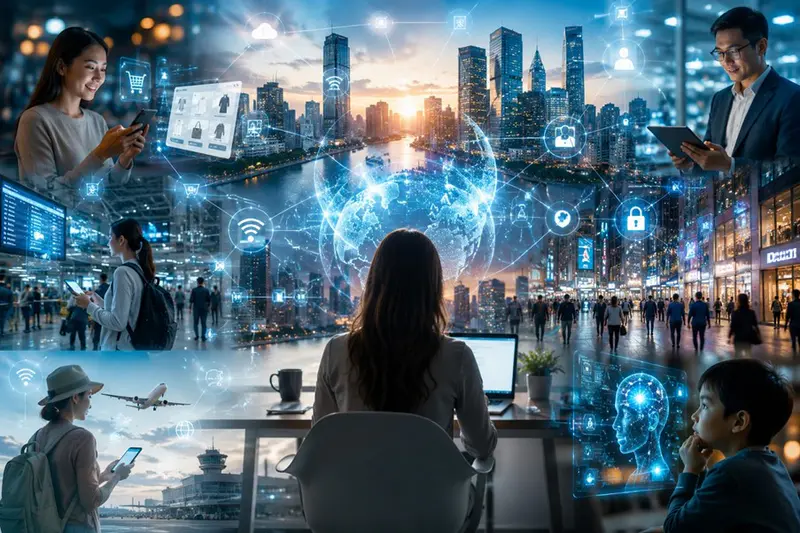
For years, the technology industry has been dominated by loud predictions and flashy headlines. Every few months, a “revolutionary” gadget, platform, or digital trend emerges, promising to completely transform human life overnight. Yet the most powerful technological shifts often happen quietly — almost invisibly — until one day society realizes that daily life no longer works the way it once did.
That silent transformation is happening right now.
Across industries, businesses are moving away from technology that simply attracts attention and toward technology that quietly removes friction. Consumers may not always notice these systems, but they are increasingly shaping how people communicate, travel, buy products, manage finances, consume entertainment, and even make decisions.
The next era of technology may not belong to the loudest innovation. Instead, it may belong to the technologies people barely notice at all.
The Rise of Invisible Technology
One of the biggest changes occurring in modern technology is the movement toward “invisible infrastructure.” In the past, technology products were designed to stand out. Companies competed to create devices and platforms that demanded attention.
Today, the opposite is increasingly true.
Modern technology companies are now investing heavily in systems that operate quietly in the background while simplifying experiences for users. Recommendation engines, predictive algorithms, automated workflows, digital identity systems, and intelligent customer service tools are becoming deeply integrated into daily life without requiring active user interaction.
Consumers no longer want complicated interfaces or time-consuming digital experiences. They want convenience. They want speed. Most importantly, they want technology to reduce mental effort.
This trend explains why businesses across sectors are prioritizing automation, personalization, and seamless integration over visible complexity. A recent study on the future of workplace automation published by McKinsey & Company highlights how automation technologies are expected to significantly improve operational efficiency and productivity across industries over the next decade.
The shift is already visible everywhere. Consumers now expect online platforms to remember preferences automatically, payment systems to process instantly, customer support to respond immediately, and digital experiences to feel frictionless.
The less visible the technology becomes, the more powerful it often is.
Why Simplicity Is Becoming More Valuable Than Features
For years, technology companies competed by adding more features. Smartphones gained increasingly complex capabilities. Software platforms became packed with tools and dashboards. Digital services expanded endlessly.
But modern consumers are becoming overwhelmed.
The average person now interacts with dozens of apps, notifications, platforms, subscriptions, and digital systems every day. Rather than appreciating complexity, many users now value simplicity more than ever before.
This shift is changing how companies design products.
The most successful technology platforms increasingly focus on reducing decisions, eliminating steps, and simplifying user journeys. In many cases, businesses are learning that fewer features can create stronger engagement if the experience feels smoother and more intuitive.
This explains the growing popularity of minimalist apps, AI-powered automation tools, and voice-driven interfaces. Technology is moving toward convenience rather than complexity.
Ironically, creating simplicity often requires incredibly sophisticated infrastructure behind the scenes.
A modern streaming platform, for example, uses highly advanced machine learning systems to make content discovery feel effortless. Navigation appears simple because enormous computational systems are handling the complexity in the background.
Consumers experience convenience while businesses manage increasingly advanced digital ecosystems behind the curtain.
Artificial Intelligence Is Becoming a Utility, Not a Product
Artificial intelligence is often portrayed as a futuristic phenomenon, but in reality, AI is rapidly becoming an invisible utility woven into everyday business operations.
Many people imagine AI as humanoid robots or highly visible chatbots. In practice, the most influential AI systems are often hidden inside ordinary services.
AI already influences:
- Search engine rankings
- Banking fraud detection
- Customer support systems
- Product recommendations
- Supply chain forecasting
- Logistics optimization
- Medical diagnostics
- Retail inventory management
- Advertising personalization
- Workplace productivity tools
The majority of consumers interact with AI constantly without fully realizing it.
This is important because it changes the economic role of artificial intelligence. Instead of existing as a standalone product category, AI is increasingly becoming foundational infrastructure — similar to electricity or cloud computing.
Businesses are no longer asking whether they should use AI. Instead, they are asking where automation and predictive intelligence can quietly improve operational performance. According to PwC’s global artificial intelligence research, AI could contribute trillions of dollars to the global economy by 2030 through productivity improvements, automation, and consumer demand enhancements.
Yet the companies likely to benefit most may not be the ones building flashy AI applications. They may be the organizations using AI quietly to improve efficiency, reduce costs, and enhance customer experiences behind the scenes.
The New Digital Economy Is Built on Trust
As technology becomes more integrated into everyday life, trust is emerging as one of the most valuable business assets in the digital economy.
Consumers now share enormous amounts of personal data online. Financial information, behavioral patterns, health details, location data, and communication habits are constantly flowing through digital systems.
This creates enormous opportunities — but also enormous responsibility.
Businesses are increasingly discovering that technological capability alone is not enough. Companies must also convince consumers that their data, privacy, and digital experiences are being handled responsibly.
This is why cybersecurity, digital identity verification, compliance systems, and privacy technologies are becoming central to modern business strategy.
Trust is no longer a secondary issue. It is becoming a competitive advantage.
Consumers are increasingly selective about which platforms they trust with their information. Even highly innovative technology companies can face serious reputational damage if users believe privacy or security has been compromised.
This trend is likely to accelerate as AI systems become more deeply integrated into financial services, healthcare, education, and workplace management.
The future digital economy may ultimately reward not just the smartest technology companies — but the most trustworthy ones.
The Hidden Battle for Human Attention
One of the most fascinating technology trends today is the growing realization that human attention is becoming one of the world’s most valuable resources.
Every digital platform competes for time, focus, clicks, and engagement. Streaming services compete with social media. Social media competes with gaming. News competes with entertainment. Productivity apps compete with distractions.
Technology companies now operate inside what many analysts describe as the “attention economy.”
But something interesting is beginning to happen.
Consumers are increasingly becoming aware of how digital platforms influence behavior, emotions, and decision-making. This awareness is driving new interest in digital wellness, screen-time management, mindful technology use, and simplified digital lifestyles.
Ironically, the future winners in technology may not be the companies that capture the most attention — but the companies that respect users’ attention the most.
Platforms that reduce noise, simplify communication, and create more intentional digital experiences could gain stronger long-term loyalty than platforms designed purely around engagement maximization.
This shift may fundamentally change how digital businesses measure success.
Smart Technology Is Reshaping Physical Spaces
For years, technology was largely confined to screens. But increasingly, digital intelligence is expanding into physical environments.
Smart homes, connected vehicles, intelligent buildings, automated warehouses, and sensor-driven infrastructure are transforming how physical spaces operate.
Modern buildings can now optimize energy consumption automatically. Retail stores can analyze customer traffic patterns in real time. Vehicles increasingly rely on intelligent software systems for navigation, safety, and performance management.
Even cities themselves are beginning to integrate smart technologies into transportation, utilities, security, and public services.
The Internet of Things (IoT) is enabling physical environments to generate and respond to data continuously. Research and market analysis from Statista shows that the number of connected IoT devices worldwide is expected to rise sharply as industries continue adopting sensor-driven infrastructure and smart technologies.
What makes this shift particularly important is that many of these technologies operate almost invisibly. People may not consciously think about sensors, predictive systems, or automation infrastructure, yet these technologies increasingly influence daily experiences.
The line between digital systems and physical reality is becoming increasingly blurred.
The Technology Industry Is Entering a Maturity Phase
For decades, the technology sector was defined by rapid disruption. Startups challenged established companies. Entire industries were transformed almost overnight. Innovation cycles moved at extraordinary speed.
But the industry itself is beginning to mature.
Many modern technology companies are now focused less on disruption and more on integration, optimization, and sustainability. Investors increasingly reward stable business models, operational efficiency, recurring revenue, and scalable infrastructure rather than pure experimentation.
This does not mean innovation is slowing down. In many ways, innovation is becoming more practical and deeply embedded into business operations.
The most valuable technologies of the next decade may not necessarily look revolutionary from the outside. Instead, they may quietly improve efficiency, simplify experiences, reduce friction, and strengthen decision-making across industries.
This quieter form of innovation may ultimately prove far more influential than highly visible technology trends.
The Future May Feel Surprisingly Normal
One of the greatest misconceptions about the future is the assumption that transformation always feels dramatic while it is happening.
In reality, major technological shifts often feel gradual in the moment.
People rarely wake up one day and realize the world has changed overnight. Instead, behaviors slowly evolve. Expectations adjust. Habits shift. Technology becomes integrated so naturally that eventually it feels ordinary.
That is precisely what makes the current technological transition so fascinating.
Artificial intelligence, automation, predictive systems, digital infrastructure, and intelligent platforms are already reshaping society — not through sudden disruption, but through quiet integration into everyday life.
The companies most likely to succeed in this environment may not simply build the most advanced technologies. They may be the organizations that understand human behavior best.
Because ultimately, the future of technology may not be about machines replacing people.
It may be about technology becoming so seamless, intuitive, and integrated that people barely notice it at all.