For decades, finance has been framed as a question of selection. The central challenge was identifying the right asset, the right company, or the right market. Success was often attributed to choosing wisely — picking undervalued stocks, allocating capital efficiently, or identifying growth opportunities ahead of competitors.
But increasingly, that framing is incomplete.
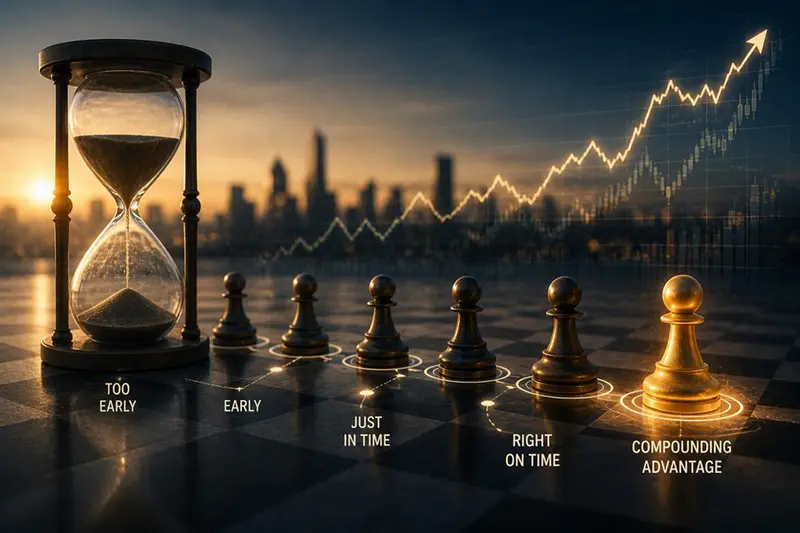
In modern finance, timing is quietly overtaking selection as the dominant variable. Not in the narrow sense of market timing—often dismissed as speculative—but in a broader, structural sense. The timing of investment, deployment, scaling, and exit is becoming as critical as the underlying asset itself.
This shift reflects a deeper transformation in how financial systems operate. Markets are faster, information is more widely distributed, and value cycles are shorter. As a result, the question is no longer just what to invest in, but when to act within an increasingly compressed and dynamic environment.
The Compression of Financial Cycles
One of the most significant changes in modern finance is the compression of cycles.
Historically, financial cycles unfolded over extended periods. Economic expansions, market corrections, and industry transformations could take years or even decades to fully materialise. This allowed investors and institutions to operate with relatively long time horizons.
Today, these cycles are accelerating.
Digital technologies, global connectivity, and real-time information flows have shortened the distance between cause and effect in financial markets. News travels instantly, decisions are executed in milliseconds, and market reactions are often immediate.
Research highlights that the increasing speed of information dissemination has fundamentally altered market dynamics, reducing the time available for price discovery and amplifying short-term volatility (oecd.org).
This compression changes the nature of opportunity.
Assets that might have remained undervalued for extended periods in the past are now repriced more quickly. Trends emerge and dissipate faster. Windows for strategic action narrow.
In this environment, timing becomes a critical determinant of outcome.
The Illusion of Perfect Information
At the same time, the availability of information has increased dramatically.
Financial markets today operate in an environment of unprecedented transparency. Data on companies, markets, and economic indicators is widely accessible. Advanced analytics tools allow investors to process vast amounts of information quickly.
On the surface, this should make decision-making easier.
In reality, it creates a paradox.
When information is widely available, it becomes less of a differentiator. If everyone has access to the same data, then the advantage shifts to those who can act on it more effectively—and more quickly.
This dynamic reinforces the importance of timing.
It is no longer enough to identify a promising opportunity. By the time it is widely recognised, its value may already be reflected in market prices. The challenge is to act at the right moment—before the opportunity becomes obvious, but not so early that it remains unrealised.
The Rise of Execution Timing
Timing in finance is not limited to entry points.
It extends to execution—how and when capital is deployed, scaled, and reallocated.
In traditional models, execution was often treated as a secondary consideration. Once an investment decision was made, implementation followed a relatively predictable path.
Today, execution itself is a source of competitive advantage.
For example, companies that can deploy capital quickly during periods of market dislocation often capture opportunities that others miss. Similarly, investors who can scale investments at the right moment—when conditions are favourable but not yet saturated—can achieve significantly better outcomes.
Research shows that firms with greater operational flexibility and faster decision-making capabilities are better positioned to respond to market changes and capture value (mckinsey.com).
This highlights a broader point: timing is not just about when to invest, but about how and how quickly to act.
Market Structure and the Timing Advantage
Changes in market structure further reinforce the importance of timing.
Financial markets today are more interconnected than ever. Capital flows across borders with minimal friction, and asset prices are influenced by a wide range of global factors.
This interconnectedness increases both opportunity and risk.
On one hand, it allows investors to access a broader range of opportunities. On the other hand, it introduces complexity, as events in one market can have immediate effects on others.
In this environment, timing becomes a way to navigate complexity.
For example, entering a market during a period of relative stability may yield different results than entering during a period of volatility. Similarly, the timing of exit decisions can significantly affect realised returns.
Academic research on global capital flows highlights how timing and sequencing of investments can influence outcomes in interconnected markets (imf.org).
This underscores the idea that timing is not just a tactical consideration—it is a structural factor.
The Role of Expectations
Another key driver of timing in modern finance is expectations.
Markets are increasingly forward-looking. Asset prices reflect not only current conditions but also anticipated future developments.
This creates a dynamic where timing is closely linked to expectations.
Investors must consider not only what is likely to happen, but also when it will happen—and how market participants will react. Acting too early can result in opportunity cost, while acting too late can mean missing the upside.
This dynamic is particularly evident in sectors driven by innovation.
For example, investments in emerging technologies often involve long periods of uncertainty followed by rapid growth. Identifying the inflection point—the moment when adoption accelerates—is critical to achieving strong returns.
Timing and Risk
Timing also plays a crucial role in risk management.
In traditional finance, risk was often assessed based on asset characteristics—volatility, creditworthiness, and historical performance. While these factors remain relevant, timing introduces an additional dimension.
The same investment can carry different levels of risk depending on when it is made.
Entering a market at the peak of a cycle may expose investors to downside risk, even if the underlying asset is fundamentally strong. Conversely, entering during a downturn may offer opportunities for value creation.
Research on market cycles shows that timing of entry and exit can significantly influence investment performance, particularly in volatile environments (harvard.edu).
This highlights the importance of aligning investment decisions with broader market conditions.
The Organisational Dimension of Timing
Timing is not just an individual or investor-level phenomenon. It is also an organisational capability.
Companies must decide when to invest in new projects, when to expand into new markets, and when to scale operations. These decisions have long-term implications for performance.
Organisations that can align their timing with market conditions are better positioned to succeed.
This requires a combination of data, analysis, and judgment.
Data provides insights into trends and patterns. Analysis helps interpret these insights. Judgment is needed to make decisions under uncertainty.
Together, these elements enable organisations to act at the right moment.
Technology and the Acceleration of Time
Technology plays a central role in shaping the timing dynamic.
Digital platforms, algorithmic trading, and real-time analytics have accelerated the pace of financial activity. Decisions that once took days or weeks can now be made in seconds.
This acceleration creates both opportunities and challenges.
On one hand, it allows for faster response to changing conditions. On the other hand, it reduces the margin for error.
The ability to process information quickly and act decisively becomes a critical capability.
At the same time, technology introduces new forms of competition. Algorithms and automated systems can exploit timing opportunities more efficiently than human actors, raising the bar for performance.
The Limits of Timing
Despite its importance, timing is not a perfect science.
Financial markets are influenced by a wide range of factors, many of which are unpredictable. External events, behavioural dynamics, and systemic shocks can disrupt even the most carefully planned strategies.
This uncertainty means that timing must be approached with humility.
It is not about predicting the future with precision, but about positioning oneself to respond effectively to changing conditions.
This requires flexibility, adaptability, and a willingness to adjust strategies as new information becomes available.
The Future of Finance as a Timing Discipline
As financial systems continue to evolve, timing is likely to become even more important.
The acceleration of information flows, the increasing complexity of markets, and the growing role of technology all point toward a future where timing plays a central role in decision-making.
In this environment, success will depend not only on identifying opportunities, but on acting at the right moment.
This represents a shift in how finance is understood.
From a discipline focused on selection and allocation, it is becoming one that emphasises timing and execution.
Conclusion: The Moment That Matters
Finance has always been about making decisions under uncertainty.
What is changing is the nature of those decisions.
In a world where information is abundant and markets move quickly, the advantage lies not just in what you know, but in when you act.
The timing game is not about predicting every movement. It is about recognising patterns, understanding context, and positioning oneself to capture value when it emerges.
Because in modern finance, the difference between success and failure is often not the asset itself.
It is the moment you choose to act.