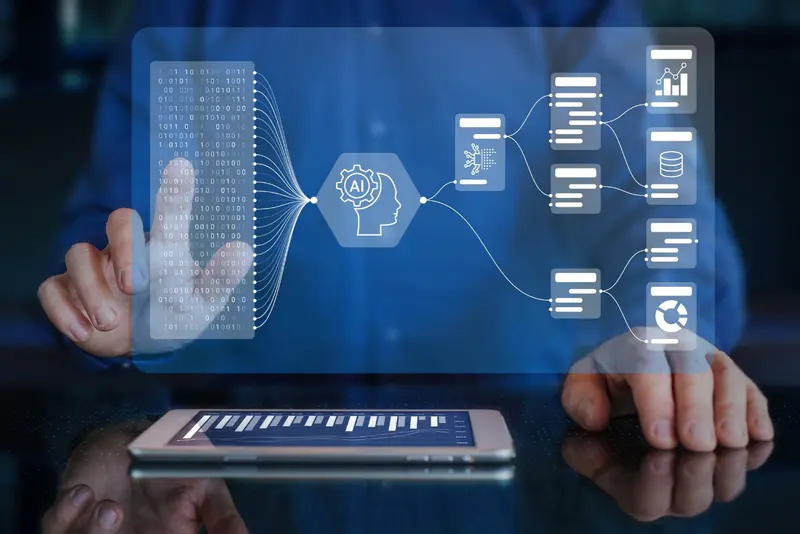
For decades, enterprise software has been designed around a familiar principle: users log into applications, enter information, complete tasks and move manually from one system to another. Whether processing invoices, approving loans, onboarding customers or managing supply chains, software has traditionally served as a tool that required people to drive every step of a business process.
That model is beginning to change.
Advances in artificial intelligence, workflow orchestration, cloud computing and enterprise integration are enabling software to become increasingly proactive. Instead of simply recording transactions or presenting information, modern platforms can coordinate data, automate decisions, trigger actions across multiple systems and recommend the next best step within defined governance frameworks. The emphasis is shifting from software as a destination to software as an intelligent participant in business operations.
This evolution is giving rise to intelligent workflows—connected, AI-enabled processes that combine automation, analytics and human oversight to improve speed, consistency and operational performance. Rather than replacing enterprise software, intelligent workflows extend its capabilities by allowing multiple applications to work together as part of a coordinated business process.
Industry analysts increasingly view this shift as one of the defining trends shaping enterprise technology. Gartner predicts that enterprises will progressively move beyond assistive AI toward outcome-focused workflows in which intelligent systems help execute business processes under appropriate governance and policy controls. (Gartner)
Software Is Evolving from Applications to Outcomes
Traditional enterprise software has generally been organised around individual applications.
Organizations deploy separate systems for finance, customer relationship management (CRM), enterprise resource planning (ERP), procurement, human resources and compliance. While these applications remain essential, employees often spend considerable time moving information between them, manually coordinating approvals and monitoring progress across disconnected systems.
Intelligent workflows seek to reduce these operational gaps.
Instead of asking users to navigate multiple applications independently, workflow platforms orchestrate activities across systems, automatically routing information, triggering approvals, updating records and coordinating tasks based on predefined business rules and real-time data.
The result is a transition from software that supports isolated functions to platforms that help deliver complete business outcomes.
Artificial Intelligence Is Accelerating Workflow Intelligence
Artificial intelligence is not replacing enterprise software.
Instead, it is making software increasingly capable of understanding context, analysing information and supporting operational decisions within existing workflows.
Modern AI-enabled workflows can assist organizations by:
prioritising work queues;
identifying process bottlenecks;
classifying documents;
extracting information from unstructured data;
recommending actions;
automating repetitive administrative tasks;
supporting exception management.
Rather than asking employees to perform every routine activity manually, AI enables systems to complete appropriate tasks while escalating complex decisions to human experts.
According to McKinsey, organizations are increasingly recognising that operational excellence—not AI deployment alone—is the primary driver of sustainable value from enterprise AI investments. (McKinsey & Company)
Workflow Orchestration Is Becoming the New Competitive Advantage
One of the most significant developments in enterprise technology is workflow orchestration.
Organizations increasingly operate hundreds of interconnected applications across cloud environments, on-premises systems and third-party platforms.
The challenge is no longer acquiring software.
The challenge is coordinating software.
Workflow orchestration platforms provide the mechanisms needed to connect:
enterprise applications;
cloud services;
APIs;
robotic process automation (RPA);
AI models;
human approvals;
compliance controls.
Gartner notes that enterprises are placing growing emphasis on orchestrating data, processes and AI rather than simply deploying isolated automation tools. Coordinating human and machine activities across business ecosystems is becoming central to digital transformation initiatives. (Gartner)
Intelligent Workflows Improve Operational Efficiency
Organizations increasingly evaluate technology investments based on measurable business outcomes.
Intelligent workflows can improve operational performance by:
reducing manual processing;
shortening approval cycles;
improving data consistency;
reducing operational risk;
increasing process visibility;
supporting faster customer service.
For example, financial institutions increasingly automate customer onboarding, identity verification, fraud monitoring, compliance screening and loan processing while maintaining human oversight for higher-risk decisions.
Similarly, manufacturers, insurers and healthcare providers are embedding intelligent workflows into procurement, claims processing and supply chain management.
The objective is not to eliminate human involvement but to enable employees to focus on judgement-intensive activities while repetitive administrative work is handled automatically.
Connected Data Is Becoming More Valuable Than Standalone Applications
One of the greatest limitations of traditional enterprise software has been data fragmentation.
Customer information may reside in a CRM platform, financial records in an ERP system, compliance documentation in separate repositories and operational metrics within cloud analytics platforms. Employees frequently spend significant time reconciling information across multiple systems before decisions can be made.
Intelligent workflows address this challenge by connecting data sources rather than replacing them.
Modern workflow platforms increasingly integrate APIs, cloud services and data orchestration capabilities that allow information to move securely across enterprise environments while maintaining governance and auditability. Instead of requiring users to manually gather information from multiple applications, connected workflows can assemble relevant data automatically at the point of decision.
This approach not only improves operational efficiency but also helps reduce inconsistencies that arise from duplicate data entry and disconnected systems.
Cloud Infrastructure Makes Workflow Intelligence Possible
The widespread adoption of cloud computing has created the technical foundation for intelligent workflows.
Unlike traditional on-premises software environments, cloud platforms provide the scalability, interoperability and processing capacity needed to support automation, AI models and real-time collaboration across geographically distributed organizations.
Cloud-native architectures allow organizations to:
integrate multiple enterprise applications;
deploy updates continuously;
connect third-party services through APIs;
support hybrid workforces;
process large volumes of operational data.
According to Microsoft, cloud platforms increasingly enable organizations to combine AI services, automation and enterprise applications within unified digital environments, allowing workflows to evolve more rapidly while maintaining security and governance.
Rather than existing as isolated systems, enterprise applications increasingly function as interconnected services operating across shared cloud ecosystems.
Human Expertise Remains Central
Although automation capabilities continue to expand, intelligent workflows are not designed to eliminate human decision-making.
Instead, they redistribute work.
Routine, repetitive and rules-based activities become increasingly automated, allowing employees to concentrate on tasks requiring judgement, creativity, relationship management and strategic thinking.
This collaborative model—sometimes described as human-in-the-loop automation—is becoming increasingly common across banking, insurance, healthcare and professional services.
Examples include:
compliance analysts reviewing only high-risk alerts;
loan officers evaluating complex applications after automated screening;
customer service teams handling exceptions identified by AI;
finance professionals reviewing forecasts generated through machine learning.
Organizations increasingly recognize that the greatest value comes from combining automation with human expertise rather than viewing them as competing approaches.
Governance Is Becoming More Important Than Automation Alone
As intelligent workflows become more autonomous, governance becomes increasingly critical.
Organizations must ensure automated decisions remain:
transparent;
auditable;
secure;
compliant;
explainable.
Without appropriate governance, automated workflows may introduce operational risks rather than reducing them.
The National Institute of Standards and Technology (NIST) highlights the importance of governance, risk management, transparency and accountability throughout the AI lifecycle. These principles help organizations deploy trustworthy AI while maintaining appropriate oversight and regulatory compliance.
Increasingly, enterprise leaders recognize that successful workflow automation depends as much on governance as on technology.
Security Must Evolve Alongside Automation
Every new workflow connection creates additional considerations for cybersecurity.
Modern workflow environments may involve:
APIs;
cloud applications;
third-party software;
identity platforms;
AI services;
mobile users.
Protecting these interconnected environments requires security models that extend beyond traditional perimeter defenses.
Organizations increasingly implement:
Zero Trust security architectures;
Identity and Access Management (IAM);
Multi-Factor Authentication (MFA);
endpoint management;
continuous monitoring;
privileged access controls.
The IBM Cost of a Data Breach Report continues to show that organizations with mature security, automation and AI-assisted security operations often experience lower breach costs and faster incident response than those relying primarily on manual processes.
As intelligent workflows expand, cybersecurity increasingly becomes an operational requirement rather than simply an IT responsibility.
Intelligent Workflows Support Regulatory Compliance
Highly regulated industries require operational processes that are both efficient and accountable.
Financial institutions, insurers and healthcare providers must demonstrate that decisions are appropriately documented, controlled and auditable.
Modern workflow platforms increasingly help organizations support:
audit trails;
policy enforcement;
regulatory reporting;
approval workflows;
document retention;
compliance monitoring.
Rather than treating compliance as a separate activity performed after operations have concluded, intelligent workflows embed governance directly into operational processes.
This shift supports both operational efficiency and regulatory resilience.
Enterprise Software Vendors Are Changing Their Strategies
Many enterprise software vendors are no longer competing solely on application functionality.
Increasingly, competition focuses on workflow intelligence.
Enterprise platforms now incorporate:
AI copilots;
intelligent assistants;
workflow automation;
process mining;
predictive analytics;
low-code workflow design;
orchestration engines.
Rather than selling isolated software modules, vendors increasingly position their platforms as environments capable of coordinating end-to-end business processes across multiple applications.
This reflects the broader evolution from software products toward intelligent operational ecosystems.
Digital Transformation Is Becoming Process Transformation
For many years, digital transformation emphasized digitizing paper-based processes.
Today's transformation initiatives increasingly focus on redesigning entire operational workflows.
Organizations are asking broader questions:
Can this process be automated?
Can approvals occur automatically?
Can AI identify exceptions?
Can systems coordinate without manual intervention?
Can employees focus on higher-value work?
These questions demonstrate that digital transformation is no longer primarily about software deployment.
It is increasingly about workflow redesign.
The Future of Enterprise Software Is Increasingly Invisible
One of the most significant characteristics of intelligent workflows is that users often become less aware of the software itself.
Historically, productivity depended on employees learning how to navigate increasingly complex enterprise applications. In contrast, intelligent workflows aim to reduce friction by allowing technology to coordinate routine activities behind the scenes.
Employees increasingly interact with:
conversational interfaces;
AI assistants;
automated approvals;
intelligent notifications;
real-time recommendations.
The underlying applications continue to exist, but users spend less time navigating systems and more time completing business objectives.
This evolution reflects a broader shift in enterprise technology—from software that requires human coordination to digital ecosystems that increasingly coordinate themselves within defined governance frameworks.
According to Deloitte, organizations are increasingly moving toward intelligent enterprises where AI, automation and data-driven decision-making are embedded into everyday operations rather than existing as standalone technology initiatives. This transition is enabling businesses to improve agility while strengthening operational resilience.
Challenges That Organizations Must Address
Although intelligent workflows offer considerable opportunities, successful implementation requires careful planning.
Organizations should consider several operational factors before scaling workflow intelligence across the enterprise.
Data Quality
AI and automation depend on reliable information. Poor-quality or inconsistent data can reduce workflow accuracy and create operational inefficiencies.
Change Management
Employees require appropriate training and support as workflows evolve. Successful transformation depends on people adopting new ways of working alongside new technologies.
Integration Complexity
Many organizations operate legacy systems alongside modern cloud applications. Achieving seamless interoperability often requires phased modernization strategies.
Governance
Clear accountability, policy management and auditability remain essential as workflows become increasingly autonomous.
Cybersecurity
Workflow orchestration increases connectivity across enterprise systems, making Zero Trust architectures, identity governance and continuous monitoring increasingly important.
Organizations that address these challenges early are generally better positioned to realize sustainable benefits from intelligent workflow initiatives.
Intelligent Workflows Are Redefining Competitive Advantage
The competitive landscape is shifting.
Historically, organizations invested in enterprise software to digitize individual departments.
Today, many organizations are investing in intelligent workflows to improve how the entire enterprise operates.
Rather than measuring technology success by the number of applications deployed, organizations increasingly evaluate outcomes such as:
operational efficiency;
customer experience;
decision speed;
resilience;
regulatory compliance;
employee productivity;
business agility.
As intelligent workflows continue to mature, competitive differentiation is likely to depend less on owning individual software platforms and more on how effectively organizations connect people, data and technology into coordinated business processes.
In this environment, enterprise software is becoming the foundation rather than the destination. The greatest value increasingly comes from the workflows that connect systems, automate routine work and enable employees to focus on higher-value activities. Intelligent workflows are therefore not replacing enterprise software—they are redefining how software creates value across modern organizations.
FAQs
What are intelligent workflows?
Intelligent workflows are AI-enabled business processes that combine automation, analytics, workflow orchestration and human oversight to improve operational efficiency, decision-making and business outcomes.
How are intelligent workflows different from traditional software?
Traditional software typically requires users to perform tasks manually within individual applications. Intelligent workflows connect multiple systems, automate routine activities and coordinate processes across enterprise platforms.
Why are intelligent workflows becoming more important?
Organizations are increasingly seeking greater operational efficiency, faster decision-making, improved customer experiences and stronger resilience. Intelligent workflows help achieve these objectives by integrating AI, automation and enterprise applications.
Do intelligent workflows replace employees?
No. Intelligent workflows are generally designed to automate repetitive and rules-based activities while allowing employees to focus on strategic, analytical and customer-facing work that benefits from human judgement.
What technologies enable intelligent workflows?
Key technologies include:
Artificial Intelligence (AI)
Workflow orchestration platforms
Cloud computing
APIs
Robotic Process Automation (RPA)
Process mining
Identity and Access Management (IAM)
Analytics and machine learning
Which industries benefit most from intelligent workflows?
Intelligent workflows are increasingly used across:
Banking
Financial services
Insurance
Healthcare
Manufacturing
Retail
Government
Logistics
Professional services
References
Gartner – Gartner Expects Most Enterprises to Abandon Assistive AI for Outcome-Focused Workflow by 2028
https://www.gartner.com/en/newsroom/press-releases/2026-04-02-gartner-expects-most-enterprises-to-abandon-assistive-ai-for-outcome-focused-workflow-by-2028McKinsey & Company – Putting AI to Work: The Operational Excellence Imperative
https://www.mckinsey.com/capabilities/operations/our-insights/putting-ai-to-work-the-operational-excellence-imperativeMicrosoft – Cloud Adoption Framework for Azure
https://learn.microsoft.com/azure/cloud-adoption-framework/National Institute of Standards and Technology (NIST) – AI Risk Management Framework
https://www.nist.gov/itl/ai-risk-management-frameworkIBM – Cost of a Data Breach Report
https://www.ibm.com/reports/data-breachDeloitte Insights – Intelligent Enterprise
https://www2.deloitte.com/us/en/insights.htmlWorld Economic Forum – Future of Jobs Report 2025
https://www.weforum.org/publications/the-future-of-jobs-report-2025/Microsoft Work Trend Index
https://www.microsoft.com/worklab/work-trend-indexAccenture – Technology Vision 2025
https://www.accenture.com/us-en/insights/technology/technology-trendsPwC – Global Digital Trust Insights Survey
https://www.pwc.com/gx/en/issues/cybersecurity/digital-trust-insights.html