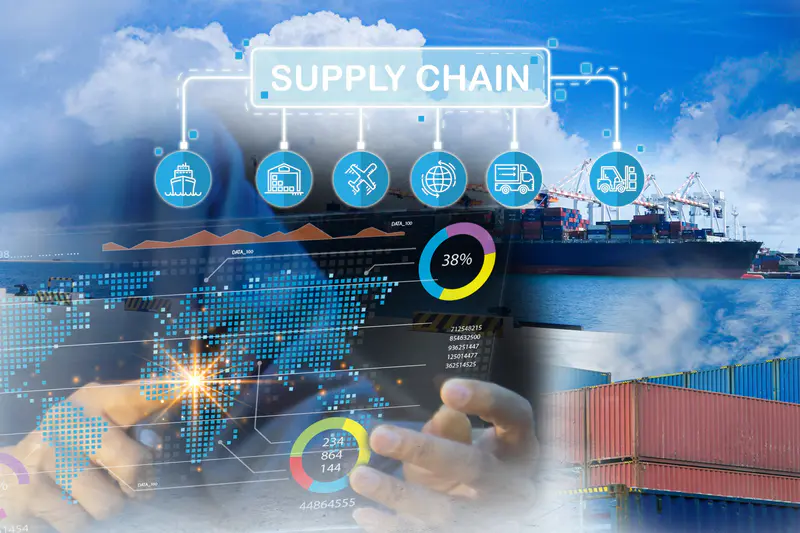
Longer routes, changing trade patterns and uneven digital capabilities are pushing companies to rethink how they balance efficiency, reliability and cost.
A different measure of efficiency
For much of the past several decades, supply chain improvement was frequently framed around lower costs, leaner inventories and faster delivery. Those priorities remain important, but recent disruptions have made reliability a more visible part of commercial planning. Businesses now face the practical task of balancing efficient operations against the ability to continue serving customers when transport links, suppliers or demand patterns change unexpectedly.
The scale of the challenge is apparent in international shipping. UN Trade and Development's Review of Maritime Transport 2025 projected just 0.5% growth in seaborne trade volumes for 2025, following 2.2% growth in 2024. It also reported that rerouting increased shipping distances, with tonne-miles rising by approximately 5.9% in 2024. These are historical estimates and projections from the 2025 report rather than a description of today's exact traffic levels.
A longer voyage affects more than the freight bill. It can extend the period between paying suppliers and collecting revenue, increase the inventory needed to maintain service, and reduce the flexibility available when demand changes. For businesses operating on narrow margins, a small deterioration in delivery reliability can have an outsized effect on cash requirements.
Resilience is not simply more stock
A common response to disruption is to hold more inventory. That can provide a buffer for essential products, but it ties up working capital and may create waste where goods are perishable, seasonal or technologically short-lived. Resilience is better understood as the ability to anticipate a disruption, adjust operations and recover without an unacceptable loss of service.
The World Bank's Logistics Performance Index emphasizes reliability alongside speed in cross-border goods movement. Its 2023 edition examined 139 countries and considered logistics services, infrastructure and border procedures. While country-level indicators cannot predict the performance of an individual company, they illustrate why delivery conditions depend on the wider transport and administrative environment.
For a manufacturer, an effective response might involve qualifying an additional supplier for a critical component. A retailer might improve demand forecasts and reorder points. A distributor might negotiate alternative routes before a bottleneck develops. These choices differ because the best solution depends on the value, scarcity and substitutability of the products involved.
The case for more visibility
Companies cannot manage risks they cannot see. A business may know its direct supplier but have limited information about the facilities, transport services or sub-suppliers on which delivery ultimately depends. Mapping critical inputs can reveal whether seemingly diversified suppliers share the same port, production region or logistics contractor.
Digital systems can help by tracking orders, monitoring inventory, exchanging delivery data and identifying delays earlier. Yet adoption remains uneven. The OECD's 2025 survey of small and medium-sized enterprises, conducted across ten OECD countries with digital-platform partners, found that firms differed substantially in digital maturity. Its survey highlights maintenance expense, training time and hardware costs as barriers; results should not be interpreted as a globally representative census of all SMEs.
Technology works best when paired with straightforward operating decisions. If a dashboard identifies a delayed shipment but nobody is responsible for authorizing an alternative order, more data may deliver little improvement. Businesses need rules for escalation, supplier communication and customer updates, not just additional software.
Diversification has trade-offs
Diversifying suppliers can reduce concentration risk, but it is rarely cost-free. A second supplier may require smaller order volumes, new quality checks, different contractual terms or additional compliance work. Bringing production closer to customers may shorten lead times while increasing labor or facility costs. The objective is not to eliminate every vulnerability, which is usually impossible, but to choose where resilience spending offers a proportionate benefit.
UNCTAD's 2025 maritime assessment describes persistent freight-rate volatility and the impact of route changes on travel times. That evidence supports contingency planning, but it does not establish that any single sourcing strategy will be superior in all markets. Companies should stress-test different scenarios, including shipment delays, supplier outages and a sharp change in demand.
Small businesses may have fewer alternatives than large multinationals, but they can still prioritize a limited set of actions. Identifying the five or ten inputs most essential to sales, understanding realistic replacement times and maintaining accessible supplier records can improve preparedness without requiring a complete systems overhaul.
What executives should measure
Resilience should be measured against outcomes, not the number of suppliers listed in a procurement database. Relevant indicators include on-time delivery, time to recover after a disruption, dependence on single-source inputs, stockout frequency, inventory turnover and the financial cost of emergency transport. Measures need consistent definitions; otherwise an apparent improvement may simply reflect a shift in the product mix.
Board-level attention is also warranted when supply chain exposure affects customer commitments or cash flow. Finance, procurement, operations and sales teams need a shared view of the trade-offs, because a purchasing decision that lowers unit costs may increase overall delivery risk.
The direction of travel is toward a more balanced definition of performance. Efficiency still matters, but businesses increasingly need to demonstrate that their supply chains are dependable under stress. Those that make reliability visible, test realistic disruptions and address the most consequential weak points will have a firmer basis for investing in resilience.
References
UNCTAD, Review of Maritime Transport 2025 — https://unctad.org/publication/review-maritime-transport-2025
UNCTAD, Maritime trade under pressure (2025) — https://unctad.org/news/maritime-trade-under-pressure-growth-set-stall-2025
World Bank, Logistics Performance Index 2023 — https://www.worldbank.org/en/news/press-release/2023/04/21/world-bank-releases-logistics-performance-index-2023
OECD, SME digitalisation for competitiveness: 2025 survey — https://www.oecd.org/en/publications/sme-digitalisation-for-competitiveness_197e3077-en.html
OECD, D4SME Survey 2025 policy highlights — https://www.oecd.org/content/dam/oecd/en/networks/oecd-digital-for-smes-global-initiative/D4SME-2025-Policy-Highlights.pdf/_jcr_content/renditions/original./D4SME-2025-Policy-Highlights.pdf