Why do some apps become part of daily life almost instantly, while others—equally useful—are quickly forgotten?
Why do certain digital tools feel indispensable after just a few uses?
And why do people return to the same platforms repeatedly, often without consciously deciding to?
The answer lies in something subtle but powerful: the digital habit loop.
It is not a single technology or trend. It is a pattern—one that is quietly reshaping how individuals interact with technology, how businesses design products, and how behavior evolves in a digital-first world.
And once you notice it, you begin to see it everywhere.
What Is the Digital Habit Loop?
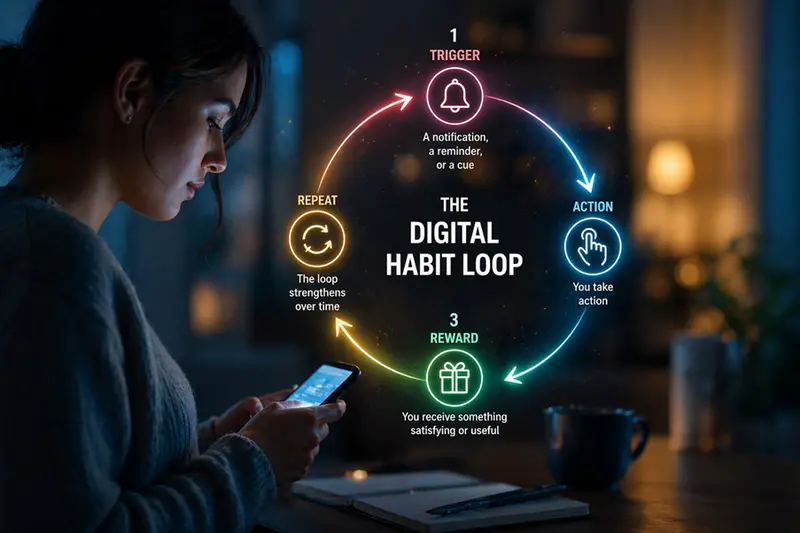
At its core, the digital habit loop is a cycle that drives repeated behavior.
It consists of three simple elements:
- A trigger
- An action
- A reward
A notification appears (trigger), a user opens an app (action), and receives useful or satisfying information (reward).
Over time, this loop becomes automatic.
Behavioral science research highlights how repeated actions, reinforced by rewards, form habits that require less conscious effort to maintain (behavioralscientist.org).
In the digital world, this process is accelerated.
Technology is designed to make the loop seamless—sometimes almost invisible.
Why Digital Habits Are Stronger Than Traditional Habits
Traditional habits—like reading a newspaper or visiting a store—require time and effort.
Digital habits are different.
They are:
- Instant
- Accessible
- Constantly reinforced
A smartphone, for example, is always within reach. A digital platform is always available.
This reduces friction.
The easier it is to repeat an action, the more likely it becomes a habit.
Research from Pew Research Center shows that frequent digital engagement is now embedded in daily routines for a large portion of the global population (pewresearch.org).
This constant interaction strengthens the habit loop.
The Role of Design in Shaping Behavior
One of the most interesting aspects of digital habits is that they are not accidental.
They are often designed.
Technology platforms carefully consider:
- When to send notifications
- How to present information
- What rewards users receive
These decisions influence how users behave.
For example:
- Personalized content increases engagement
- Clear feedback encourages repeated actions
- Simple interfaces reduce friction
This is not manipulation—it is optimization.
The goal is to create experiences that are intuitive, useful, and engaging.
From Usage to Dependence
As digital habits strengthen, they move beyond occasional use.
They become routines.
People begin to:
- Check updates without thinking
- Rely on platforms for information
- Integrate digital tools into daily decisions
This shift from usage to routine is significant.
It changes the relationship between users and technology.
Technology is no longer just a tool—it becomes part of behavior.
How Businesses Are Responding
Organizations are increasingly aware of the importance of digital habits.
Instead of focusing only on features, they are focusing on engagement.
This includes:
- Designing products that encourage regular use
- Creating value through consistent interactions
- Building trust through reliable experiences
According to McKinsey, companies that successfully create engaging digital experiences are more likely to retain customers and drive long-term growth (mckinsey.com).
This reflects a broader shift:
Success is no longer defined only by what a product does—but by how often and how naturally it is used.
The Subtle Influence on Decision-Making
Digital habits do more than drive usage.
They influence decisions.
For example:
- Frequent exposure to certain information shapes perception
- Regular interactions create familiarity and trust
- Repeated experiences influence preferences
Over time, these effects accumulate.
They shape how people:
- Choose products
- Form opinions
- Make decisions
This influence is often subtle—but powerful.
The Balance Between Engagement and Overload
While digital habits offer benefits, they also create challenges.
Constant engagement can lead to:
- Information overload
- Reduced focus
- Decision fatigue
This is why balance is becoming increasingly important.
Effective technology use involves:
- Prioritizing meaningful interactions
- Managing time and attention
- Avoiding unnecessary distractions
Organizations are also exploring ways to design for healthy engagement—creating value without overwhelming users.
The Evolution of Digital Behavior
Digital habits are not static.
They evolve.
As technology changes, so do the ways people interact with it.
For example:
- Voice interfaces are changing how people access information
- AI-driven tools are influencing how decisions are made
- Real-time systems are shaping expectations for speed and responsiveness
This evolution reflects a broader trend:
Behavior is adapting to technology—and technology is adapting to behavior.
Why This Pattern Matters
The digital habit loop is not just about individual behavior.
It has broader implications.
It influences:
- How businesses design products
- How industries compete
- How information spreads
Understanding this pattern provides insight into why certain technologies succeed—and why others do not.
It also highlights the importance of designing systems that are not just functional, but meaningful.
The Human Element Remains Essential
Despite the influence of digital habits, human judgment remains critical.
People still choose:
- What to engage with
- How to use technology
- When to disconnect
Technology can shape behavior—but it does not control it.
The most effective use of technology combines:
- Smart design
- Thoughtful use
- Human awareness
This balance ensures that technology enhances, rather than overwhelms, daily life.
A Quiet Force with a Lasting Impact
The digital habit loop operates quietly.
It does not announce itself.
It does not demand attention.
But it shapes behavior in powerful ways.
It influences:
- How people interact with technology
- How businesses engage with users
- How decisions are made
And because it is subtle, it is often overlooked.
Final Thoughts: The Pattern Behind the Screen
The next time you reach for your phone, open an app, or check an update, consider what is happening.
Not just the action—but the pattern behind it.
Because the most important changes in technology are not always about what we see.
They are about how we behave.
And the digital habit loop—quiet, consistent, and powerful—is one of the forces shaping that behavior every day.